“Pandemic Right Here! Got That Pandemic!”

We looked at the clock: it was minutes before midnight. We were exhausted, the chips and guac had been exhausted hours before, and the dog had lost interest from the moment the events transpired. The only real reason we had to continue was because the fate of all humanity rested on our weary shoulders. Such is the sense of burden that is felt as we played through four different games of Pandemic.

A board game that relies on collaboration amongst players instead of competition, Pandemic finds players racing around the globe treating infections and feverishly trying to discover the cure before another epidemic wrecks havoc on the globe. In effect, the players are working together to beat the game; either we all win or – as was most oft the case for us – we all lose.

A game that can be played by anyone, we found ourselves deliberating every action and discussing (or arguing) strategy. We were metacognitive in our decision making process. We highlighted what failed in past games (deciding to ignore the wildfire-like spread of disease in Asia, for instance was a particularly terrible strategy) and relied on our various locations, cards, and other game attributes to eventually beat the game.

Exhausting and exhilarating, Pandemic is the kind of game that warrants careful analysis – the game’s design helps rupture any sense of confidence; at any moment all hell can break loose when another epidemic strikes. As a learning tool, Pandemic is particularly intriguing. By the end of our final game – we saved the world at 12:53 a.m. – we informally reflected on how our game playing adapted to the nature of the game, our communication skills, and the way the game’s design was a useful instructional tool.

As I continue to think about game play within the classroom, I think Pandemic and a general resurgence in board game playing is helping me distill the basics out of what is meaningful in a gaming and learning environment.

I’m in the middle of watching this great Google Talk by Pandemic’s creator, Matt Leacock.

Additionally, I’m looking to create a regularly meeting board gaming group to look at the role of social interaction and strategizing when playing. (I guess I should also mention I’m reading this and planning to work through the exercises, if anyone else in Los Angeles is interested in collaborating.)

At Manual Arts, Mr. Carlson and I have created the Strategic Gaming Club – meeting during lunch and after school a group of students regularly plays games ranging from Mancala to Chess to Hungry Hungry Hippos. And if we’re able to sneak in a few sessions of Settlers of Catan and Pandemic, I’m sure the world would thank us.

“Got that Pandemic!”

Riding the Dissertation Wave

I recently got a Google Wave preview invite (thanks you-know-who). I’m excited about the collaborative options but anxious to be able to actually collaborate with people other than the handful lucky enough to be testing the preview version.

I created my first semi-working wave today the initial text is as follows:

Thinking about technology, open access, and still wanting something to be generally single-authored, I’m wondering if I can use Google Wave to work through my dissertation.

Some initial questions:

Can I put a Creative Commons license on a wave?

Can I make a wave “public” so I can have anyone read it and make suggestions but still be able to moderate it? I think this could be more managable than creating a Wiki, but just as participatory.

Do I need to wait until this is out of “preview” to best connect others?

I’ve got a meager four contacts on Wave at the moment and only two are aware of the research/teaching behind the dissertation stuff I’ll get around to.

For now, I’m going to try to throw a few ideas up here, play around with this and see if anything can come of it.

I’m trying to experiment with ways to post the wave here, though with everything still a “preview,” I can’t ensure things will stay put. In the meantime, I’m curious about thoughts about proceeding with public head-scratching, drafting, defending, and writing of the dissertation. Is this kind of open approach even going to be accepted?

Patterns Towards Da Future

A paper I co-authored (and partially adapted from my work in a course about Dewey and democracy) was presented at the Association of Computing Machinery (ACM) Multimedia Conference in Beijing last week.

Though you (or your institution) will need a subscription to download it, the abstract (below) and the list of citations (linked) should give you a fair idea of where we went with this. If you’re interested, the actual paper can be found here.

ABSTRACT

The authors developed and tested a hyper-local air quality sensor network and a fictional game narrative to evaluate the pedagogical potential of Alternate Reality games for high school students in Los Angeles. This study examined how Deweyan concepts of learning can be applied to game play. The authors found that students developed a unique language to discuss real pollution issues within a fictional construct. Engaging in both civic engagement and educational rigor, student learning was situated in a framework of instruction John Dewey outlines as counter to traditional models of schooling. Despite limitations, including some authoritarian and competitive structures implicit in games, students found new reasons to communicate with real-world adults in verbal and written form. Game-based learning inspired substantial qualitative progress and high levels of engagement among students, compared to traditional teaching methods.

Correspondences

“I mean, the urge to depict and the longing to see depictions is very strong and very deep within us. It’s a five-thousand-year-old longing – you see it all the way back to the cave paintings, this need to render the real world. We don’t create the world. It’s God’s world, he made it. We depict it, we try to understand it. And a longing like that doesn’t just disappear in one generation. Art is about correspondences – making connections with the world and to each other. It’s about love in that sense – that is the origin of the erotic quality of art. We love to study images of the world, and especially images of people, our fellow creatures. And the problem with abstraction, finally, is that is goes too far inwards and the links become tenuous, or dissolve, and it becomes too hard to make those connections.” – David Hockney

[Been reading art books in between all of the academic stuff. Finding they help shift the way I’ve been looking. I’m finding the intended dialogue between Hockney and Robert Irwin one that will play out as I start making decisions about classroom space in the next few weeks. Likewise, I’m thinking about the connections that the classroom may have with the work of Sarah Sze.]

“Tell Them I Am Busy”: Comics and Counter-Narrative

One of the things that Mr. Carlson and I experimented with using during his intersession was comics. Specifically, we had students create comic strips through Pixton.

The best thing about having students create stories through Pixton is that it just happens. Other than guiding students through the registration process, Mr. Carlson and I never needed to actually tell students how to create the comics they would make. They just happen. After students made a couple in response to class discussions, films, or readings, the Pixton comics reached a tipping point with some of the class; now, students are regularly authoring comics and sharing their work with a network of other comic creators.

Because Pixton is such an intuitive interface, students are able to quickly generate stories or opinions on any part of the world they are interested in. What’s compelling is the way the medium becomes a mode for generally silenced voices to comment and critique life at Manual Arts and to punctuate experiences that are otherwise normalized through an adult lens.

Again, I can take no credit for the astute implications behind the comic below (if your browser isn’t getting along with the Flash window below, view the comic here).

more about “people’s perspective of MAHS by kflor1“, posted with vodpod

Defaced of Embraced?: A Much Needed Guest Post

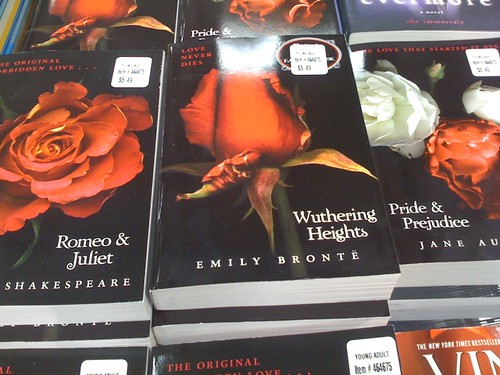
So it starts with this:

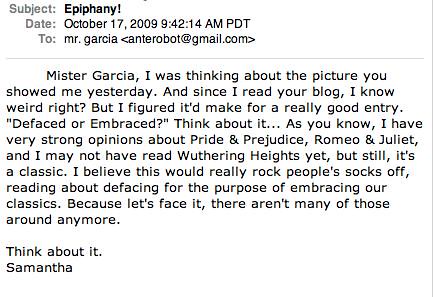
And then I get this:

So I send this:

As I think about the many conversations happening around YA literature, youth literacy, and reading efforts in our schools, it’s more and more obvious that the people that matter most in these discussions are not being included. I couldn’t be more thrilled to get someone as knowledgeable in the Twilight series to add such an astute addition to the current discourse. If you’re wondering, Sam’s a natural writer and voracious reader. Already with a few completed drafts of novels under her belt, she will be helping me co-teach a unit to her fellow seniors in a week in conjunction with National Novel Writing Month (NANOWRIMO).

I know my email said this would be a conversation, but I’ve written enough and want to yield the proverbial mic to Ms. Diego for the duration of this post (your comments are encouraged to further this discussion with a true expert).

Defaced of Embraced?

Everyone has had to read them. Many have been asked to analyze the writing. Some of us even read them for the sole purpose of a good book. But, have our classic novels become a victim of this Twilight epidemic?

Sure, many girls are going crazy for this newly famous Edward Cullen character. Yet, you have to wonder what Mr. Darcy, Elizabeth Benett, Cathy, Heathcliff, even Romeo & Juliet have to do with Twilight. Although these classic stories have been mentioned in the series, it leads me to believe that what was once a nice reference has become an act of violation.

Recently, our classic novels have been reprinted with different book covers; those which resemble that of the Twilight series. While they may look new and shiny, the same story remains. However, I can’t help but realize that that feel of the authenticity of the book has been defaced. And yes, Pride and Prejudice may not have had the best cover to begin with, but the story itself was so different than anything read before. Which is what made it that much lovelier.

Stephenie Meyer, author of the Twilight Saga, was inspired by five different books throughout her skyrocketing writing career. Classics such as Romeo & Juliet, Pride and Prejudice, Wuthering Heights, The Merchant of Venice and even A Midsummers Night’s Dream. These are all wonderful classics that, let’s face it, have inspired many other writers, but to take that inspiration to a new level is to be questioned.

By now it is obvious that Meyer is a big fan of our wonderful classics. We welcome her to our club with open arms. Does that mean that what she does afterwards will affect us? Of course.

Everyone is different, everyone likes things and appreciates them differently. Meyer’s reprinting process is an act of embracing those wonderful novels that once inspired her. To others, like myself, it has become an act of defacing such wonderful novels that will remain fresh and great for years to come. I do not wish them to become sellouts.

There’s just one more question: Do we want our spectacular novels to be known as the books that inspired Stephenie Meyer? Or do we want them to be known for the writer’s who did anything and everything to put a good book in our bookshelves?

Think about that next time you hit your local Barnes and Noble and see Pride and Prejudice with a flowery cover.

Book Room Discovery #3 – A Captioned Photo Essay

Book discovered in bookroom in envelope addressed to “Manual Arts High School Book Room.” Obviously, it needed to be opened. This is what was found. Letter can be seen tucked in the front of the book.

Perhaps the greatest letter that will be mailed to Manual Arts anytime soon.

Look at that photo of Ol’ Pop!

The exposition is of a get-down-to-business, fundamentals of the game, variety. It’s a no-nonsense talking to of the ethics and strategy of multiple sports.

Little known fact: Pop Warner was quite the poet – perhaps a moving elegy for our current 3-2 Toiler football team.

The book is currently being kept in an undisclosed location. Though our library does not assess late fines (thank goodness for this person!), it also has a tendency to discard an extraordinary amount of books. I’m wary to return this artifact from another epoch in case it is simply tossed into the ether of yellowed pages.

Are there more book room discoveries to share? Only time will tell.

Dada Analysis and Trial & Heir

Hadn’t been able to make it out to Machine Project in a while and thoroughly enjoyed tonight’s lecture about failure by Monochrom’s Johannes Grenzfurthner.

Looking at how failure is a crucial component in negotiating success in the digital world and, along the way, highlighting the failure of the movie industry, the failure of Dubai, the failure of Austria’s lack of history, the failure of the Coke/Pepsi battle, the failure of competition, etc., Grenzfurthner suggested that the one way toward a more transformative society is through play within the failure of technology (we can’t wait for a free market to sort all this crap out for us). Though his message was a playful one, I think the repurcussions behind the hacking ethos and the suggestion to celebrate failure – of, for example, the computer owner that imagines that his cup holder isn’t the right size, not realizing that he’s failing to use his CD-ROM drive correctly – are resounding and important . Look at the Monochrom “Brave New Pong” project as an example; the game’s players no longer fail since you control the ball and the computer ensures that it will never actually fall off the table, wastefully. Does this matter for education? You bet – think about the transformation that would occur within our students if they moved beyond the binary right/wrong & pass/fail mentality; what would it look like to explore and play within the twilight limitlessness of traditional failure?

Machine Project continues a steady smattering of awesome events. Despite the hefty price tag, consider joining me in a few weeks at their upcoming benefit.

Looking Through You: The Beatles and Critical Pedagogy

I’ve been in serious Beatles mode lately. You can chalk it up to the full court press marketing effort behind the recent remasters and Rock Band if you’d like.  In any case, as I have been re-listening through the discography, I’ve been drawn to some of the songwriting refrains that pop up now and then. Most explicitly, I’m excited by the way that I think the Beatles represent aspects of Critical Pedagogy within their catalogue.

I am pleased by the dialectical nature of many of the later Beatles songs. Though I don’t claim to be an expert on their songwriting practices, looking at the writing credits as well as post-Beatles albums, I’d attribute most of this trend to John Lennon. [While I’ll generally appreciate the patient, spiritual acceptance of circumstance that plods throughout George Harrison’s All Things Must Pass, I think that Lennon comes across as the more needed voice apropos critical pedagogy.]

The dialectic at the heart of many Beatles songs is one that finds discussion of differing viewpoints and a synthesis toward understanding and consensus. It is a deliberative process, if still imbued into the structure of a standard three-minute pop song.

Let’s look at “With a Little Help From My Friends” as an example:

Would you believe in a love at first sight?

Yes I’m certain that it happens all the time.

What do you see when you turn out the light?

I can’t tell you, but I know it’s mine.

Oh, I get by with a little help from my friends,

Mmm I get high with a little help from my friends,

Oh, I’m gonna try with a little help from my friends

That the song’s verse becomes a literal exchange between two voices demonstrates how dialogue helps move ideological bodies toward common visions, goals, understandings. It offers a problem-posing model of inquiry aligned with revolutionary pedagogical practice.

Similarly, “Hello Goodbye” finds the dialectic between opposing voices. The song is a one-sided take at the vexing process that often yields consensus. Talking with my advisor about the difficulties in determining content within my classroom, it’s clear that the dialectic between the “social justice” content and the necessary, “traditional” content is what’s at stake. A dialogue between these two, typically polarizing areas is the place for student exploration – the distance between the misunderstood “Goodbye” and the whimsical, portentous “Hello” is one that reflects this tension. Listen for the contradictory background vocals running throughout the second half of this song (“I say yes, but I may mean no” & “I can stay ‘til it’s time to go” as examples).

And again, while praise for the Beatles is not exactly in short supply – and yes there are those contrarians that downplay the influence of the Beatles or even claim that the Animals are their more preferred group (?!) – I think what I’m presently finding most interesting about the group is the way they embrace tension and conflict within songs. As I type, “Penny Lane” is playing in the background (I threw on The Magical Mystery Tour solely based on my ever-evolving fascination with “Your Mother Should Know”). What would have been a typical, plodding – and still highly successful – pop song is elevated by the inclusion of baroque instrumentation –a motif the Beatles would regularly revisit. The syrupy vocals of “Penny Lane” are thrown into discord by the unexpected French Horn. And then, later in the album, you hear the way the dialectic extends across time: “All You Need if Love” finds the Beatles reframing “She Loves You” and even Glenn Miller’s “In the Mood” into a more contemporary vision of “love.” Likewise, “Glass Onion” on the White album revisits Lucy, the Walrus, and perpetuates the Paul is Dead hype.

I realize there are tomes and dissertations and academic gobbledygook that intellectualizes what the Beatles have done. And while most of this post may be cast-off as yet another example of academic navel gazing, I’m sincere in my efforts to point toward the pedagogical suggestions that Lennon and company are making; the revolutionary potential of the dialectic is one that can’t be downplayed here.

To conclude, I want to compare two statements. In “The Word,” the Beatles harmonize while singing, “Say the word and you’ll be free.” Similarly, Paulo Freire, in so many words explained that to name the word is to name the world. A literal change is made manifest through the power of literacy and the power of dialogue. I think it’s a vision shared by the Beatles and Freire and it’s a vision that we can share, together, as educators.