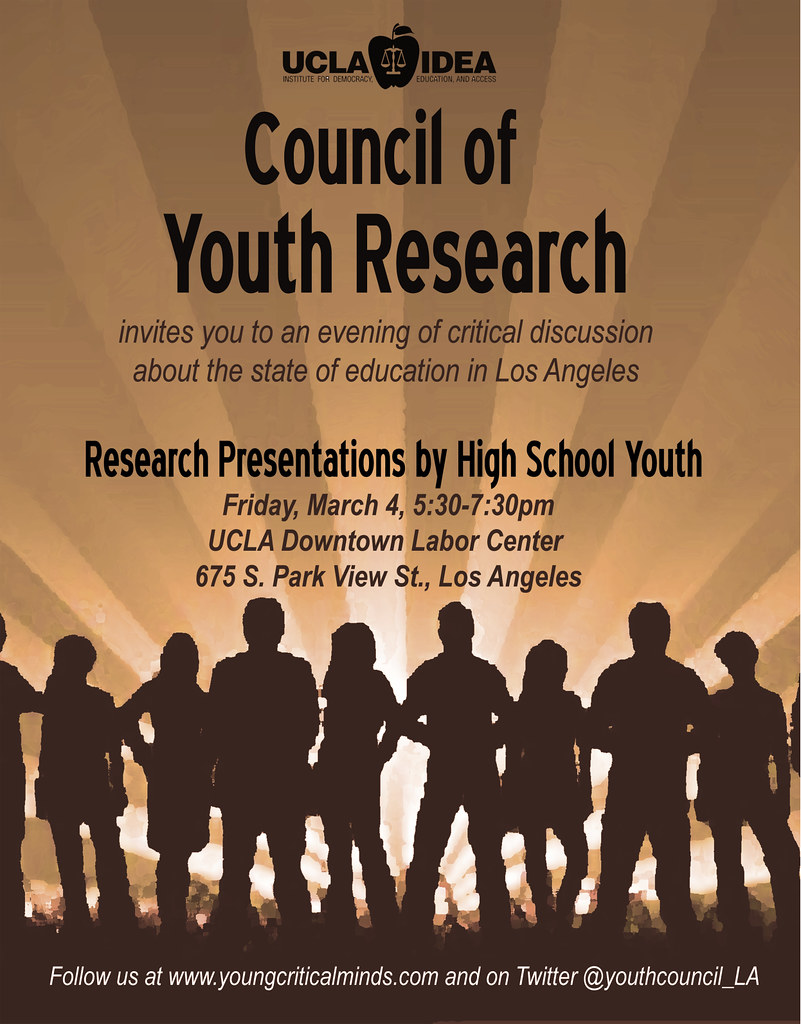
Please Check out the Council of Youth Research in Downtown Los Angeles Tomorrow
Leave a reply
If anyone is headed to the Digital Media and Learning Conference in Long Beach, I’ll be sneaking around much of Friday and Saturday.
On Friday, I will be doing an afternoon Ignite talk. I will be elaborating on learning implications related to this post.
On Saturday, I will be part of a panel called, “DML Competition Winners and Race to the Top: Adopting Participatory Learning in Schools.” I’ll be sharing updates on the Black Cloud, and educational policy impacts on digital media.
If you’re at the conference, please send me a note so we can meet in person.
Hasbro, I want to tell you something: I grew up playing Monopoly with ever-evolving house rules that varied everything from the value of dice roles, to jail-breaking bribery, to lucrative Free Parking.
Reading about the changes that Hasbro has made to the game makes me concerned. Changes in board games like this doesn’t feel like healthy adaptations; this is pandering.
I’d imagine many educators would point to a concern about elementary math skills lost without the transaction of paper money. However, I think the main problem with this proposal is the lack to augment, challenge and reinvent when all of the rules and arbiters of those rules are hidden inside a speaking, electronic box.
Part of what is so important about the value of games is the way they make us challenge traditional thinking. Passing go, for instance, would be a relatively easy task without the rules that you must move in one direction and only on legitimate squares. Gambits of investing in trains, calculating income tax, and desperate negotiations to complete monopolies are part of the social interaction of playing games.
And while the importance of socialization of games is addressed, the value of “cheating” is just as important. Cheating – changing rules and exploring more creatively how to problem solve within a gaming environment are just as valid in learning to play, compete, and evaluate the structures of power placed within a game.
Games like Little Big Planet, level editors for popular first person shooters, and avid affinity spaces online for gaming strategy, guilds and lore are all extensions of why the creepy tower in the middle of the Monopoly tower thwarts creativity, fun, learning. Ultimately, limiting one’s freedom in authoring gaming components within Monopoly will reduce the success of garnering a newer, “digital” audience and transferring videogame components to board games.
Quick check in:
Today and tomorrow, I will be attending the Labor-Management Collaboration Conference in Denver.
This should be an interesting space and I’m cautiously optimistic about what will transpire. If you’re not able to make it in person, follow the event’s twitter hashtag: #ed2gether. I will try to update as I can.
Also, Thursday and Friday I will be at the annual NABE Conference in New Orleans.
If you are at either of these events, or in the area, let me know.
I’ll check-in soon about the various places I’ll be for this year’s DML Conference.

This New York Times article about search is fascinating. As much as I found the general peek into the power of a company like Google insightful, I think the article points to long-term implications for educators.
As we continue to think about the productive world that our teens are engaging within, how students navigate online, how students question the content they seek, produce, or encounter, and how students promote or validate sources is going to become a crucial part of their critical literacy development.
While traditional critical literacy and even critical media literacy engage in evaluating the power structures underlying authorship and production, this literacy is expanding to include how this information is found, suppressed, promoted. “White hat” and “black hat” optimization (whether knowingly or unknowingly as J.C. Penny claim in the article) are part of the components of critical literacy that educators could not have foreseen.
More than simply teaching students how to use critically the tools of search that are available (from Google to library catalogs to online databases like ERIC and DataQuest), we will need to engage in an inquiry into how results are yielded, how to parse metadata, and to question the programming structures at hand. Program or be programmed indeed. Perhaps educators should be demanding a large place at the table at this summit?
Time for a new course of study. If you haven’t read the article yet, please take a look.
It’s a weird feeling finishing a book as long as The Instructions and pretty much wanting to pick it up and start re-reading it.
Most of all, I’m impressed with the pacing of the book. For something that should feel like it moves at a glacial pace (the first 300 or so pages pretty much cover a single day of school for the protagonist), the text races toward the inevitable. Gurion may or may not be the Messiah, but the process of watching him push toward action is thrilling.
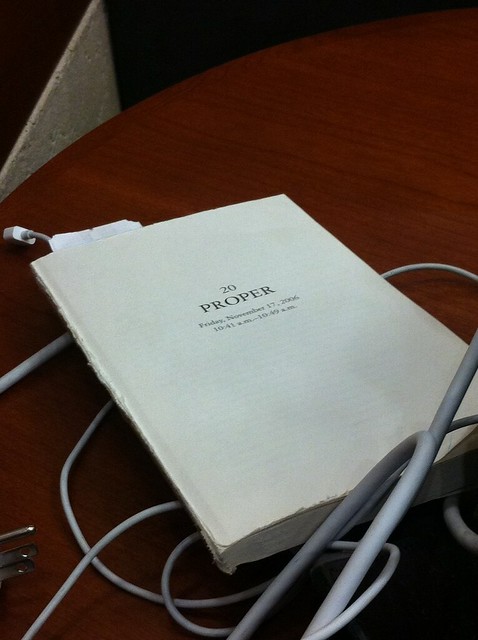
I generally struggle recommending longish post-modern-y texts because they are often so singular in their appeal to English Lit geeks. That this one plays with Jewish (Israelite?) scripture, is told with the cocky slang of middle school students, and presents violence in ways that is actually horrific in its calculated distance is even more of a reason one would shy away from suggesting this as the next book for light reading. All that being said, I think this book deserves a larger readership and that most readers would become a part of Gurion’s army of scholars if willing to crack the pages of the lengthy tome. As I mentioned earlier, the actual size of the book – while charming in design – is going to be a barrier from getting people to pick it up.
So I’ve been waking up later and later lately. Cutting it ever closer to not making it to school before the bell rings. I’ve been blessed with a traffic-lite commute (and on the 110?!).
My luck has made me wonder what will happen when our economy turns itself around. Will a better Los Angeles labor force and lowered unemployment rate mean an increase in my traffic?
Selfish thoughts, I realize. And yes, I’m willing to wake up an extra ten minutes earlier if it means a few more of you are also gainfully employed. Feel like the Freakonomics dudes should totally write a chapter about this.
[This post is my second set of comments related to Edwidge Danticat’s Create Dangerously. The entire exchange between Daye and I can be found over here.]
Daye, thanks for checking in with the comments last week.
As we’re talking about chapters 3 and 4 this week, I am again struck by titles. It’s hard to really buy that “I am Not A Journalist” is a declarative statement by the author as she does little here but report on the death and aftershocks of a close friend, activist, radio-journalist. It reminds me of Magritte’s “The Treachery of Images.” And while I was personally oblivious to the effects of Jean Dominque’s influence, I can understand how listening, like reading in the first chapter of the collection, is poised as a political act.
Like one of your final comments, I’ve been thinking about the roles that Danticat places herself in and how these may relate to the immigrant youth I’ve been teaching for the past six years. Danticat quote’s Dominque, “The Dyaspora are people with their feet planted in bother worlds. There’s no need to be ashamed of that.” I reflect on a conversation with one of my students years ago that started off the class by declaring, “Mr. Garcia, when we come to this country, we become different people.” He was initially referring to the way he lost his “second” last name as a result of traditional American conventions (and the fact that school documents simply don’t have the space to include the characters from two last names). The discussion in the class, however, circled around the transformation – one that often felt shameful – for the students throughout the class.
Daye, I’m wondering if you could talk about how diaspora is seen as a character in Lwa. Is it too the “floating homeland” around which your characters reside? This is also a good place for me to briefly step out of my role as critic and remind readers about Daye’s awesome film project on Kickstarter. Please consider making a donation to her project – even a small contribution will help her, too, create dangerously.
A couple of years ago, I created a unit plan for my students called “Voices of Struggle.” Its overarching goal was to locate students’ ideologies in the eye of the storm of larger, global conflict. Books like Persepolis, What is the What, and Invisible Man acted as exemplars for students to ultimately record and literally voice the way the world has helped shape who they are and how they have helped shape the world. I liked the way these two chapters melded the singular struggle across generations, a father’s cause taken up in the writing of a daughter.
Daye, you talked about the liminal state in which you are creating work. Do you relate to the role of memory that Danticat describes in chapter 4? I know Lwa revolves around memory too. Would you mind talking about this?
For next week, since they are slower chapters (and to make sure we wrap this up before you move from pre- to actual production), what do you say about covering the shorter chapters that make up the middle of the book. I’m proposing we comment on chapters 5, 6, 7, and 8. Any objections?
Lastly, I know a few other people have been reading through Danticat as well. Please email me or post your reflections on these chapters as comments. We will include them in the exchange and welcome the extra “immigrant” bloggers.
Teaching ninth graders, the past month has been one centered around themes of conflict as my class analyzes Romeo and Juliet. Over this and a couple of future posts, I wanted to share some of the work my students and I have been engaging in. Essentially, the role of the seminal, ninth grade text, has shifted. No longer can students simply read and analyze Romeo and Juliet. Instead, it is not an option to include materials that exist outside of the original text; it is an imperative part of understanding the text. I’ll return to this idea after sharing some examples.
Utilizing the Flip Cams that Peter and I used for our What Son Productions course, the students will be recreating their own versions of scenes from the play. This is not an original or a very creative idea (more about that in a minute). What is interesting, though, is the process of reading Romeo and Juliet across different interpretations. As we read a scene, we may screen a scene from the 1996 Lurhmann interpretation as well as the 1968 Zeffirelli interpretation. We are then utilizing a 4×4 graphic organizer to note key differences between the original source, two films, and our own ideas of how the scene could be produced. These products are becoming the basis for a production log the students are creating as they note where one version may fall short – Tybalt being too aggressive to Romeo in the 1996 version before Mercutio becomes a “grave man,” for instance.
As I mentioned, the concept of asking students to recreate their own versions of scenes isn’t a very new one. In fact, as more and more students have easy access to tools of production – as these tools have become ubiquitous – it’s easy to see student work samples online. However, the vast, vast majority of these samples appear to be from overwhelmingly white communities. And these versions are taking significant liberties in their portrayal of urban reenactments of Romeo and Juliet.
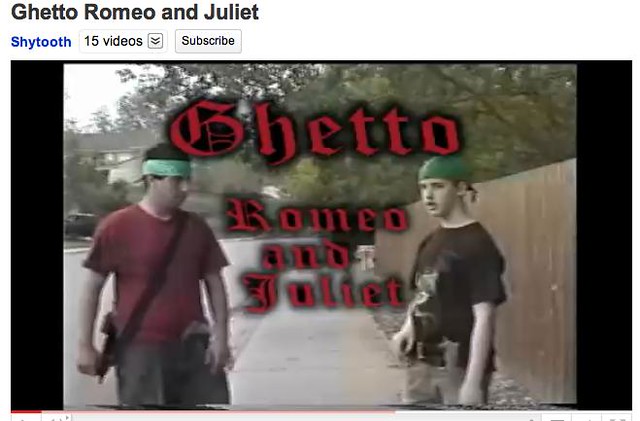
Over the course of a week, I began each class by screening a 3-7 minute YouTube clip. I simply searched “Gangster Romeo and Juliet” and a deluge of student-created videos showed up showing “ghetto” versions of the play. [This was inspired by a conversation about developing this unit with my colleague Peter Carlson.]
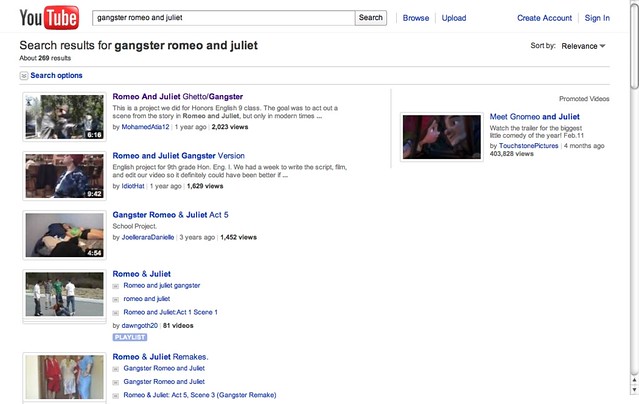
This ghetto, however, is technically the community my students live and go to school in. This ghetto is stereotyped by white students in ways that at first issued guffaws. My students found the videos funny at first. However, after a couple of days, students said they felt “mocked.” They said that the videos didn’t show things correctly, were making fun of the community, and actually lacked textual understanding of Shakespeare’s words (several of the films, for instance, abbreviated Abraham’s name the same way that Luhrmann’s did).
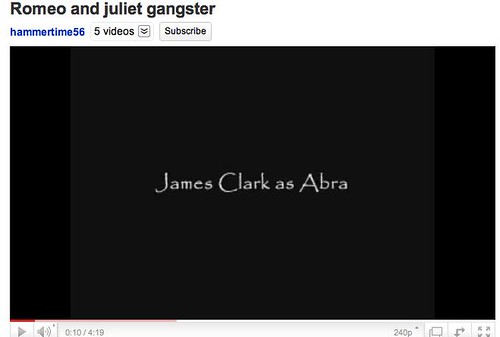
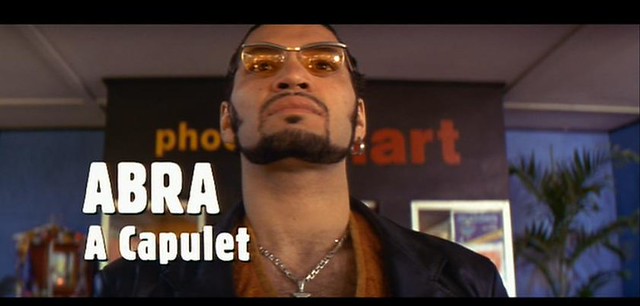
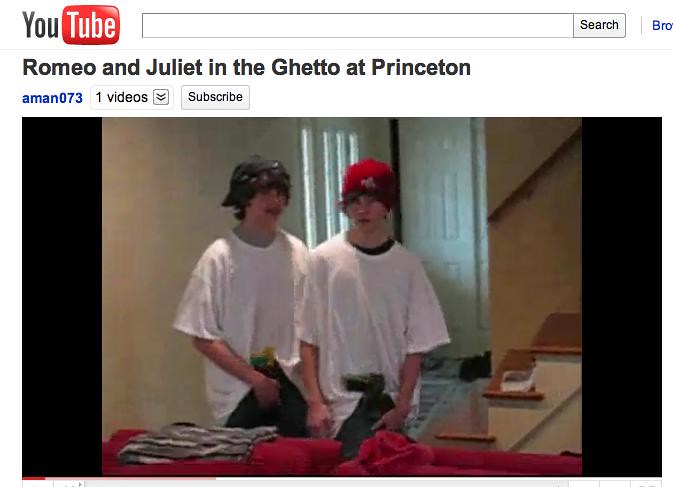
Often times, these videos are posing these ghetto versions in lush, rural or suburban communities:
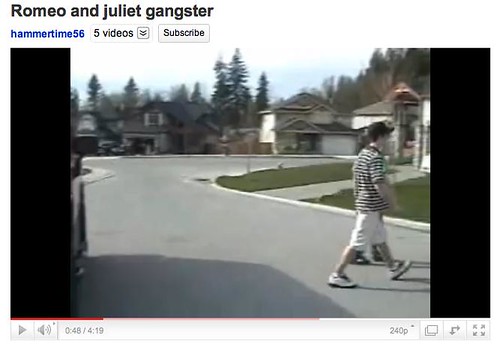
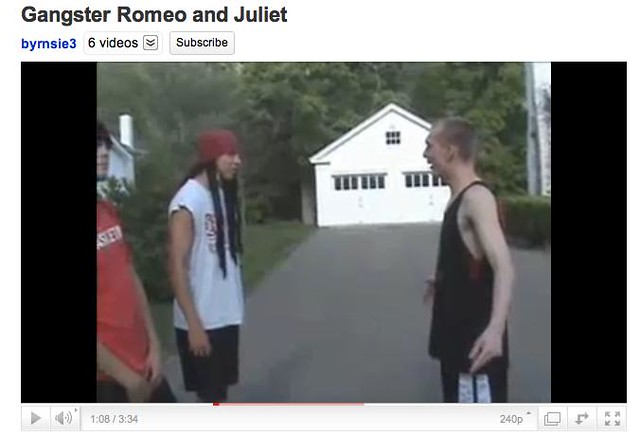
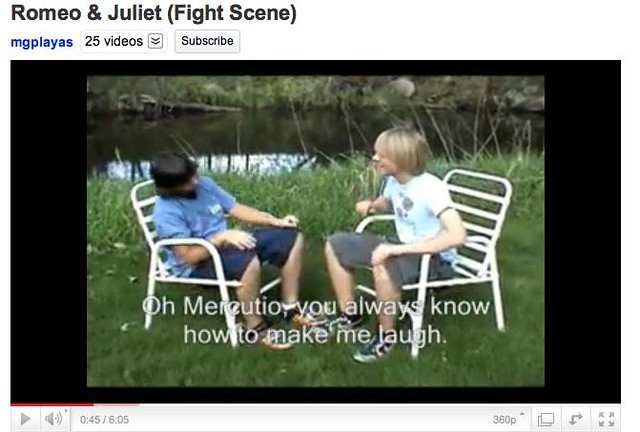
I want to underscore that I am not using these examples to criticize the students that have made them. However, when discussing them with students, we have noticed that there are not similar “ghetto” versions made by people of color. And if they are not creating them, essentially, an incorrect truth about what the ghetto is and how people act within it is being reified. My students shifted uncomfortably in their seats as they began thinking about the messages that a critical mass of lighthearted “ghetto” student clips are sending; these paired with YouTube clips of student fights are furthering stereotypes of student behavior and expectations.
As educators, our role is changing; the power of student production is a necessary tool for critical analysis. How can these tools break down existing assumptions?
As a class, my students are thinking about how they can create videos that respond critically to the samples they’ve seen, accurately reflect a nuanced understanding of their neighborhoods & worldviews, and express thematic interpretation of the canonical text. It is the necessary hard work I am excited about seeing develop in the next two weeks.
Again, as I said in the opening paragraph, the role of Romeo and Juliet is much more inclusive than simply the 92 pages of the Dover edition that my students have each been asked to purchase. The culture and understanding of the text is inclusive of a rich body of knowledge, assumptions, and continuing dialogue with the work through writing, acting, and recording. Social networking, new media, and a changing access to technology means that simply summarizing plot and theme is disregarding the other critical skills students need to learn in an English class.
I wrote a book review in the latest issue of Interactions. It can be found here.