Merit Pay for Students: Testing and Concerns

So tomorrow and Wednesday my school will administer the California High School Exit Exam (CAHSEE). In the past, there has been concern that some students have not taken the test “seriously.” Some of my past seniors, in fact, have retaken the test because they said they simply raced through it because it felt inconsequential (even though they need to pass it to officially graduate).

However, when I look at the work in my classroom and data from other measurements at the school, it’s pretty clear that many, many of the students have a lot of academic strides to make before they can pass the test. While participation and engagement may be part of the challenges our students face, quality instruction is probably most important.

Which is why the following excerpt from a faculty email is so problematic:

Every Student Who Passes a CAHSEE Test Earns a Prize as follows:

Proficient on Both Sections = iPad, IPod Touch, iPod Shuffle or $20 gift card

Proficient on 1 and Pass on Other Section = iPod Touch, iPod Shuffle, or $20 gift card

Pass on Both = iPod Shuffle or $20 gift card

Pass on 1 section = Gift Cards of $5-$20

Remember to tell your students a Pass Score is 350, and a Proficient Score is 380.

Additionally, another Small Learning Community (SLC) teacher emailed the following:

To [specific SLC] Teachers

Please remind our [SLC] 10th grade students that are taking the CAHSEE for the first time, and score proficient on both the math and english, they will receive $50.00.

They must score proficient on both tests. Also, we will raffle a pair of tickets to the Laker game February 22nd, as well as, other prizes for [SLC] students who show up both days and

show a sincere effort while taking the exam.

Hoping the best for all our students.

To me, it would be one thing to reward participation on the exam. However, when students are being rewarded (beyond intrinsic rewards) for passing the exam, it creates a false hierarchy on campus. My prediction: the students in the magnet academy, the NAI program, and a handful of students in AP & the honors tracks will clean up and get lots of rewards and the students that need the most academic support will feel deficient. There is some (problematic) support to the notion of paying students to get good grades. However, this differs significantly from performing on a single test over a two day period. We may be trying to reward diligence and participation, but the model looks–to me–like we’re instead penalizing struggling students for systemic poor teaching.

Support Lwa and Create Dangerously

First of all my good friend and filmmaker Dehanza Rogers is currently trying to raise funding for her magical-realist, Haitian short film, Lwa. Please take a look at her Kickstarter page. Really, even a small contribution will go a long way to helping support a filmmaker I believe in.

Over the next couple of weeks, Daye and I are reading through Edwidge Danticat’s latest collection of essays, Create Dangerously,  and have agreed to post a few comments back and forth. We did this once before a while ago and it’s not too late for you to grab a copy and join us as we read at the accommodating, glacial pace of two chapters a week. [Though I know Daye’s familiar with Danticat’s work, this collection got my attention via this post.]

For me, I am reading this book largely oblivious to the Haitian culture from which Danticat is writing and I’m hoping to use this dialogue as a space to understand better both the space of art from which both Danticat and Daye are producing from and within.

I’m struck by the fact that the titles of the first two chapters of the book serve as gentle and opposing commands: “Create Dangerously” and “Walk Straight.” As if the role of the “Immigrant Artist at Work” traverses the careful balance of producing with criticality and toeing an existing conceit. An interesting balancing act; I know how this tension is played out in the public eye for Danticat based on her reflections in “Walk Straight.” Daye, I’m curious how you are working between both of these.

As for the content, I like the way Danticat’s own perspectives as a creator are steeped in a history –familial, national, cultural, universal. The Haitian political figures that begin the book, the subterfugre, assassinations, and secret police reminded me Graham Greene’s lesser work, The Comedians and I was pleased to see Danticat reference it directly (as well as Greene’s exile from Hatia as a result of his choice of dangerously creating the accurate portrayl of the dictatoriship within the novel). [As a brief aside, I want to point out that I purchased The Comedians as a used bookstore solely because of a blind faith in Greene’s writing and the incredible cover art.] I am struck by the idea that, “there is probably no such thing as an immigrant artist in this globalized age.” While I don’t necessarily agree with Danticat’s claim here, I am curious about what authorial advantages are gained by vantage of the “immigrant” in the flattened world so many are pointing to.

I don’t want to make this too long as Daye and I will be checking in over the course of the book, so I’ll end by examining a quote from the second chapter: “Anguished by my own sense of guilt, I often reply feebly that in writing what I do, I exploit no one more than myself.” I’ve find myself empathizing with Danticat’s claim here and wonder how you, Daye, see this quote in relation to your own work and in particular to Lwa.

Bored, Doodling, and Caught in the Act: How Livescribe Can Make You A More Exciting Educator

After discussing research strategies with peers and doing some online ‘vestigating, I recently bought a Livescribe Echo.

Briefly, the Livescribe pen essentially records audio as you are taking notes. As simple as that sounds, what’s most valuable is that it plays back audio tied to exactly what you were writing at the time – instead of listening through an entire lecture or trying to queue up to a moment you remember, you can tap on a jotting, chart, or note and the audio from the moment you were writing will play. It’s intuitive and user friendly and not necessarily affordable for widespread consumption yet. (Here is a useful article that talks about Livescribe and its potential.)

Particularly due to the need to create robust fieldnotes based on in-class instruction for my dissertation, the ability to record and pinpoint audio moments in a classroom that are tied to my own (sloppy) handwritten jottings looks to be a valuable asset.

And while a couple of cursory Google searches yield interesting reading on the role that some are seeing Livescribe as a tool for ethnography, its challenges, and risks of deceit, I have been thinking about its potential as a tool for pedagogical feedback.

Last weekend, as I sat through a panel at the MLA convention, I momentarily spaced out and began absentmindedly doodling on the Livescribe notepad. Later, as I reviewed my notes and queued up the audio for relevant jottings I took during the recording, I glanced at the scribbles I made in the notepad’s margins. Because of the way the device works, I could listen to the exact moment that a speaker lost my interest.

While I can’t afford a class set of Livescribe pens for my students (and I’m not sure if that’s necessarily the best way to invest in technology for my classroom), it would be interesting to give an arbitrary student a Livescribe in class each day. By simply listening to the audio from anytime the student draws, sends a note to a classmate, or begins working on something for another class, teachers can quickly note when their lessons are less effective and they are not communicating in a way that is maintaining interest.

I am now amassing pages that are empirically showing when I become naturally bored in meetings and presentations. I can think more critically about my role as a participant or audience member and could conceivably provide feedback to others based on this. Now it’s time to equip my students with the same possibilities.

[One note about Livescribe: though they are relatively affordable, the paper that Livescribe pens write on is proprietary. You need to purchase specific notepads and printing out your own isn’t the easiest thing to do. It would be nice to be able to buy Livescribe printing paper to make handouts, printout essays and do audio peer-review. I plan to write to the company about this shortly.]

MLA and UCLAWP

A last minute heads up:

I will be presenting as part of a panel on Digital Pedagogy tomorrow at the MLA Conference. Details:

MLA Presentation: 639. Where’s the Pedagogy in Digital Pedagogy?
5:15-6:30, Platinum Salon F, J. W. Marriott

This session will share the great number of practical and philosophical questions surrounding what it means to “teach digitally” today. We want to focus attention away from “toolism”—a preoccupation with new technologies for the sake of newness and technical power—and direct attention toward the pedagogy that technology and collaboration can unveil.

If you’re in LA and attending the conference, please come by and say hello. I will post my slides for this presentation here … soonish.

Also, if you are a teacher and you hate sleeping in on Saturdays, please come check out the FREE Writing Project workshop I will be leading with Clifford Lee:

UCLA Writing Project Advanced Institute
January 8, 2011 from 9 am to noon.
Moore Hall, room 2120.

No charge for this seminar!

Suggested parking is Pay By Places in Lot 2, located at Hilgard & Westholme, for $10.00.

Clifford Lee and Antero Garcia will focus on the immediacy of technology as a part of the contemporary writing process for youth. Read about the workshop below and then email us that you are coming!

In May 2010, the Pew Research Center noticed a continuing trend of Black and Latino youth far outpacing Whites in the use of the Internet on mobile devices. More and more of our urban students are utilizing the Internet and related technologies for myriad forms of communication—though not always via channels appreciated in school—including but not limited to social networking, blogging, and multimedia production. What does all this mean for the educators of these students?

This workshop will illustrate how digital literacy skills in a multitude of forms are critical in helping teachers address the challenges of the opportunity gap while helping students produce powerful texts that serve to recognize, value, and incorporate their knowledge and experiences. Building on the existing tools you’re already familiar with, this workshop is not about simply learning how to use technology as it is using technology to augment critical literacy within the classroom.

Please bring any tools (digital recorders, digital cameras, FlipCams, laptops, microphones, etc.) and/or a lesson plan or project you’re interested in exploring further in our workshop.

We may be using some of the following tools during this workshop: Podcasting, Prezi, Edmodo, digital storytelling, Wordle, VoiceThread, Tumblr/blogs, Flipcams/video.

iDefer

I was already jotting out notes in response to this article in the New York Times about iPads in the classroom, but Cathy Davidson’s response captures my sentiments.

I will say that the $1 million plus that my school is spending on laptops and smart-boards is a similar, if less trendy, example of utilizing new technology to reinforce archaic classroom structures. If we aren’t using the tools for new modes of learning, if we aren’t reinventing the classroom space and experience, we are subverting student potential with shiny gadgets. Just last week, Kanye inspired me to write about this exact problem:

Is it really the best we can do to simply duplicate textbooks and textbook practices when equipping students with iPads and mobile devices? Screen reduced to nothing more than digital page?

Cutting Down The Instructions and a Wilde Diversion

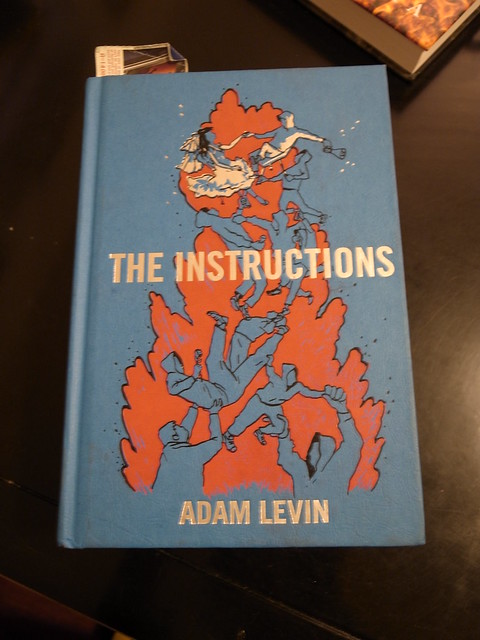
So, I’m reading The Instructions. Only a handful of pages in and I’m excited about the journey this book is intending. I also like the feel of this book. Like other McSweeney’s publications, it’s a beautifully designed item.

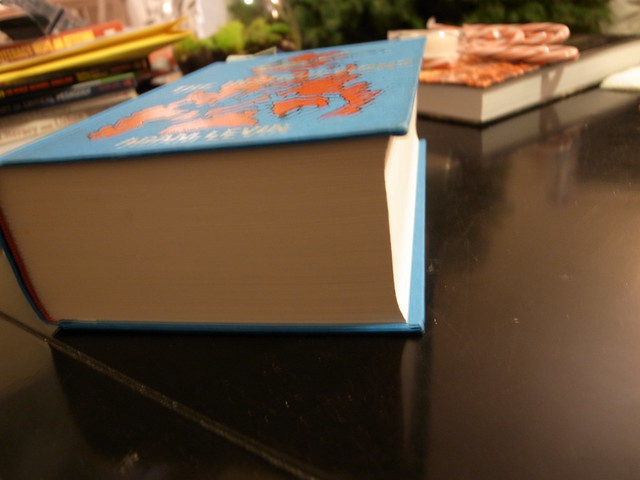
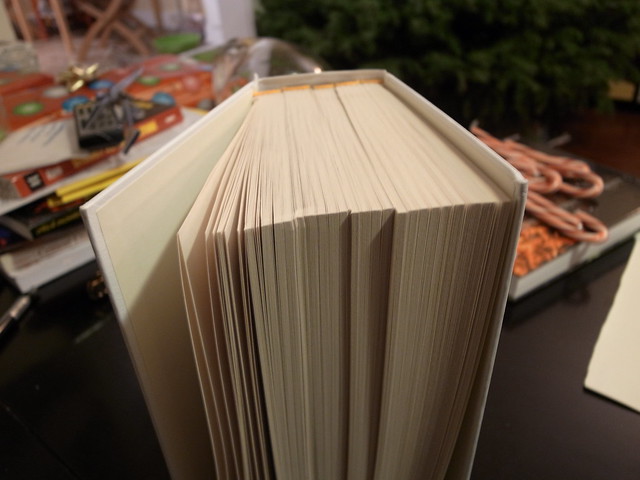
Its physicality is the very argument against e-readers. At the same time, the book is staggeringly big:

With my laptop, notebook, and mishmash of teaching materials, it literally doesn’t fit in the bag I bring to work each day. This is, indeed, a compelling argument for e-readers (especially considering that an iPad is a typical component of my daily arsenal).

Did I mention that there is no digital copy of The Instructions? As much as it would make this situation much easier, I like that I have to hold the pages as Levin’s Gurion ben-Judah Maccabee intended.

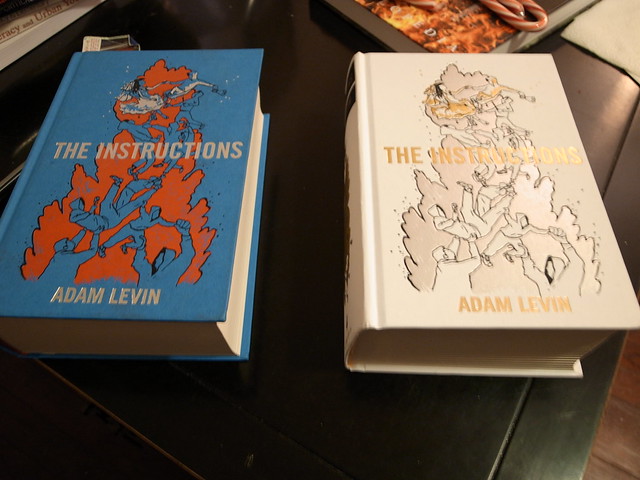
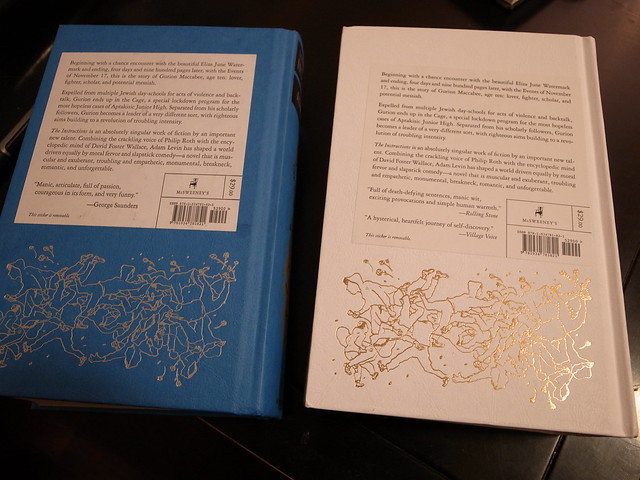
So I bought another copy.

I bought a copy that was to be slaughtered for the greater reading good. It arrived a surprising, innocent white. And once again I was captured by the intense beauty of The Instructions as Object. I almost turned against my original blue copy until I noticed the strangely askew sticker placement on the back.

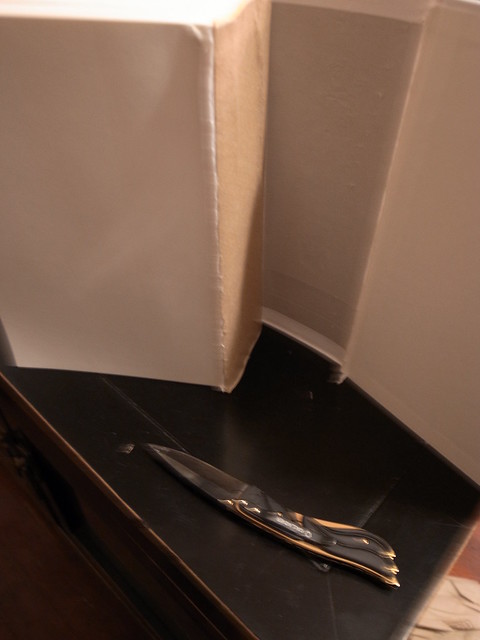
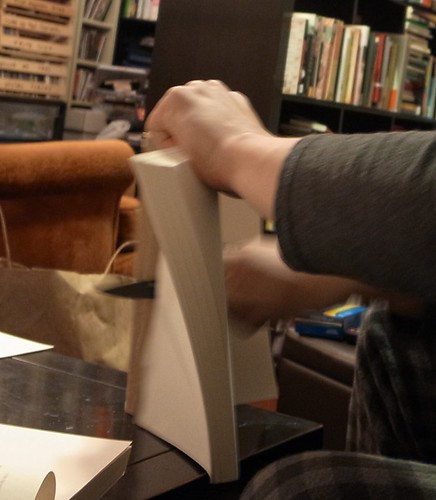
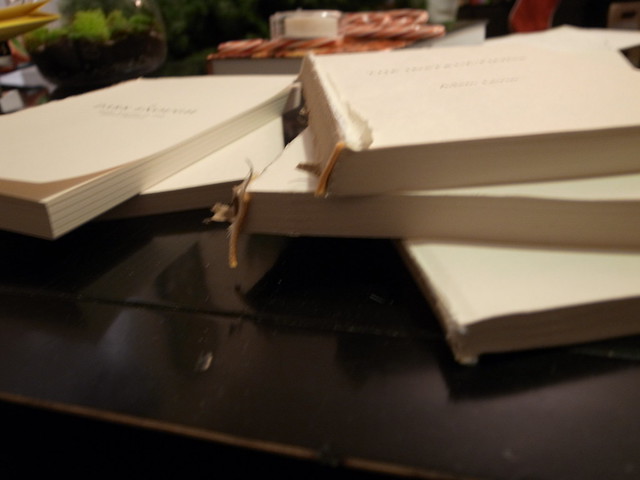
And the hacking began.

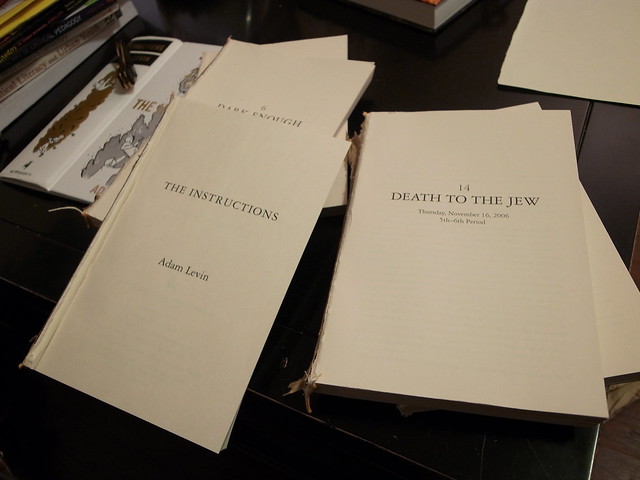
I first cut the book from its hardcover, and found suitable chapter ends with which to cut the book. Now in five digestible tomes, I can cart the book in fragments.

As I cut into the literary flesh I was reminded of El Gaviero who, in one of his earlier adventures – perhaps “The Snow of the Admiral” – also brought along only tattered fragments of greater books due to size and space. I also drew inspiration from the recent reading of Skippy Dies; the edition I read was spliced across three paperbacks housed in a handsome box, making it ever the easier book to transport. A similar appreciation was felt for the same version of 2666.

Finally, searching for the appropriate places in the text to sever text from text, to create neat piles of books, I scanned the top to see if cutting specific signatures of the book would be feasible. This did not meet my preference for separations at the end of chapters so didn’t pan out. However, I was reminded – in tracing this line of thinking – of a fragment of a literary anecdote: while doing an undergraduate fellowship at the Clarke Library, I was shown a book that was unique in the library not for its content than for its state of being. As one of the foremost collections of books by, from, or related to Oscar Wilde, the book in question (though its name is of course lost to the ineptitude of youthful obliviousness) was a gift from Wilde to his lover at the time. However, after receiving the book, Wilde’s companion rejected Wilde. The book, now owned by the Clarke Library is a treasure in that the top signatures of the book were never cut; the pages could not be opened without these being cut. The book is an artifact of a relationship run stale; Wilde’s gift nothing more than a weighty reminder of a past romance, nothing to be consumed or to even pretend to have opened.

But then comes the spinsterish head of academia: I believe a researcher expressed an interest in reading this particular copy of the Clarke’s collection. Does the library cut open the book for the needs of academia? Or preserve the book’s unrelinquished secrets in the spirit of historical veracity? Honestly, I don’t remember what decisions were made. The story itself comes as little more than a literary reverie.

A diversion, I realize, but one that brings me back to pure fascination of books in their dusty, hefty, and sometimes unwieldy physicality.