2010 in Music and My Beautiful Dark Twisted Pedagogy

I can’t say I would have anything entirely surprising in a top albums of 2010 list. You can tell when an album stays with you when your favorite song skips from one track to another until you-one moment-realize that you’ve had secret trysts with all of them; Lisbon and This is Happening both hold this distinction for me. Of these, Lisbon gets the slight edge over LCD Soundsystem if only for the stunning one two sucker punch of the closing tracks.

However, as much as these were my favorite releases, I feel that the year was one for Kanye. His album was justly heralded by critics and I think West and Co. masterfully marketed it in a way that educators should be paying close attention to.

For the greater part of 2010, Kanye West has been on my cultural radar. He’s done this deliberately and he’s done it in a way that’s made his presence, his performances, and his music something of a conversation with friends, students, and now—dear reader—with you.

By the time the album leaked, weeks before it’s official release, its music was anything but surprising – Kanye had already leaked the majority of the tracks as free downloads over the months – one song a week, featured others in a short film, and even given away the album’s bonus track. Deliberately, I was privy to Kanye’s thoughts, his music, and his oh-so-famous rants.

Musically, the album is an assemblage of the best of what Kanye has to offer without ever seeming like pastiche. The album’s two-track finale is the surprising highlight for me and I’m glad to see the playful exchange with Gil Scott-Heron that now continues across three albums.

Just as the album was finally released and the G.O.O.D. Friday series concluded, I finished reading New Literacies by Lankshear and Knobel. The book reinforced a bevy of literature I’d been reading through for my own research. Near the end, the authors discuss the internet proliferation of “memes” and what they can mean in terms of education.

Kanye’s every step in releasing the album, from ludicrous twitter messages to on-air blowups to banned album artwork meant that there was not a day that I couldn’t catch up with the latest in the Kanye-verse. In all of these Kanye has evolved the hip-hop mixtape to its proper 2.0 configuration: it is, too, an always-on amalgam of music, personality, and hype.

[Queue hip-hop for dummies paragraph:] The role of mixtapes is one that (as far as rap is concerned) dates back to the early days of hip-hop in the late ‘70s. Splicing together popular rap verses with unreleased hip-hop beats, mixtapes were underground commodities traded and sold by the aficionados within a somewhat exclusive subculture. Though it’s been years since mixtapes have actually been distributed as cassettes, the idea is still the same; otherwise unreleased or un-cleared samples are released non-commercially. Transitioning from tapes to CDs and now to direct Internet downloads, mixtapes have lately been co-opted by mainstream rappers to sustain interest between album releases. Lil’ Wayne, in particular, has benefited from a plethora of mix tape releases that have helped make him a popular rapper with both mainstream radio listeners and with online media consumers. No longer are mixtapes simply an extension of the listening experience for rap fans. Instead, they act as previews and major marketing ploys for rapper artists. Additionally, they may signal an artist’s credibility with rap fans.

But this is where the mixtape ends and Kanye deconstructs it; instead of the mishmash of 40-70 minutes of free music, Kanye slowly strings along track after track over months. Enticing the listener, responding and changing music as responses are blogged and status-updated. The silly mashup of unexpected artists that is typically reserved for mixtapes becomes a centerpiece for the album: indie darling Bon Iver’s lilting voice is paired earnestly with the hip-hop/club encounter on “Lost in the World”.

The pervasive nature of Kanye’s approach to marketing My Beautiful Dark Twisted Fantasy is something educators can lift. How can we deconstruct classroom pedagogy to move beyond traditional application of emergent technologies? Is it really the best we can do to simply duplicate textbooks and textbook practices when equipping students with iPads and mobile devices? Screen reduced to nothing more than digital page? And what about the continuous nature of Kanye’s approach? His persistence and personality are what helped transfer knowledge, interest, and passion for his work. How can this 2.0 approach be adopted for classroom use?
“I remember downcast eyes and secret whims”: Books Read in 2010

Seeing how I’m only pages into the 1000+ page novel The Instructions and likely won’t be finished anytime soon, now seems like an appropriate time to review my year in reading. Again, discounting the many articles and chapter selections that have been thumbed, read, and annotated, here’s a breakdown of what my reading time was spent with:

Books read in 2010: 108

Comics and graphic novels included in reading total: 17

Books of poetry included in reading total: 
5

Books reread included in reading total: 3

Academic & Education related books included in reading total: 23

YA and Junior Fiction books included in reading total: 19

A few thoughts and highlights (maybe you wan’t to compare them to last year’s):

The single best short story collection I’ve read in a long, long time is Stories of Your Life and Others by Ted Chiang. If you take no other recommendations, I strongly recommend seeking this one out.

In terms of highlights, my year ended with a run of rather fantastic fiction that came out this year. In particular, Skippy Dies and Room were tremendously fun reads I can’t imagine anyone disliking. Enough praise (and criticism) has been heaped on Freedom to make anything else here seem like hyperbole. Be that as it may, I struggled getting through the first third or so of this book before it completely enveloped me and left me just awed by the end – the last sentence perhaps the apotheosis of a stellar text. Along the lines of popular novels, I am left wanting to know Larson’s larger plot arc for the Millennium series. As formulaic as the texts were, I’ll admit to having been caught up in all three when reading them.

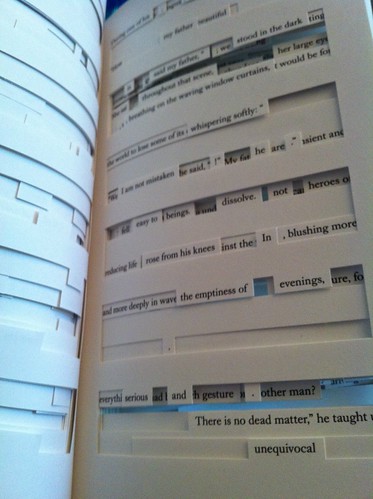
A fitting addition to the BSRAYDEKWTDWT collection, Tree of Codes is as beautiful as it is perplexing a read. The process of creation (both by the author and the publisher) is thrilling and the end result is as much art-ifact as it is poetic narrative. This post’s title and image are representative of the lucid wakefulness that is evoked through the cobweb-like pages that stick and pull from each other.

I also spent a significant chunk of reading time on YA and junior fiction, which is probably one of the best tips I can give to newer teachers; having a handful of tomes you can book talk to the most wayward of readers will go miles in keeping reading sustained throughout the year. As much as I flew through popular works like the Hunger Games Trilogy, I Am Number Four*, and the Uglies, I would point to Looking For Alaska as the title I keep coming back to. Just a great read as a whole and I can’t say that John Green’s other works have disappointed both in the classroom and as leisure reading. Going Bovine is also a quick read, despite its heft. For a slightly younger audience, Neil Armstrong is My Uncle and Other Lies Muscle Man McGinty Told Me is great. The ending felt telegraphed from the opening chapters and yet I still felt myself caught up emotionally in the way Marino pulls the plot together nicely in the concluding pages.

Essex County is a great graphic novel – so different from Lemire’s current series, Sweet Tooth. I recommend both as entry points for people that don’t consider themselves comic book readers.

Oh, I’m pretty sure that Stoner is heaped with praise annually by anyone that encounters it. That being said, it is just incredible. If you don’t believe me, the singer of the band that put out my favorite album of the year also agrees [music of 2010 post to follow shortly].

* The story behind this series, its author, and his marketing plan are a pretty fun (if somewhat infuriating) read too.

The Uncanny Valley and Higher Ed

Read this today and can’t say I’m that surprised. It’s an article that’s pretty much circulated and discussed on an annual basis for the past few years.

For me, I am reminded, when reading this, of the Uncanny Valley – the concept that robots repulse us the closer they get to approximating human attributes (think Tom Hanks in Polar Express or Jeff Bridges in the new Tron). Though there is a larger argument about the capitalist underpinnings of the academy, I find it interesting how there is a building mass of individuals approaching professorship, despite the steep drop-off in terms of job opportunities. The analogy falls apart under scrutiny, but in general, it feels like becoming a professor–like being human­–is the pinnacle to which grad students are reaching. However, the closer they get to finishing, the more repulsive the environment actually becomes: few jobs and underpaid temporary positions.

I Want to Tell You Something

So I picked this up a bit ago and I’m ready to put it to use. I’m not entirely sure for how long, but I’d like to try to eek out a postcard a day to kick off 2011. I think part of this process will be a game. I’m working it out as I go along. I’m going to call it “I Want to Tell You Somethng” and I want you to play along:

If you would like to get a postcard in the mail at some point next year, please email your address to anterobot asperand gmail dot com.

How I learned to stop worrying and just drop $40 to become a more efficient writer

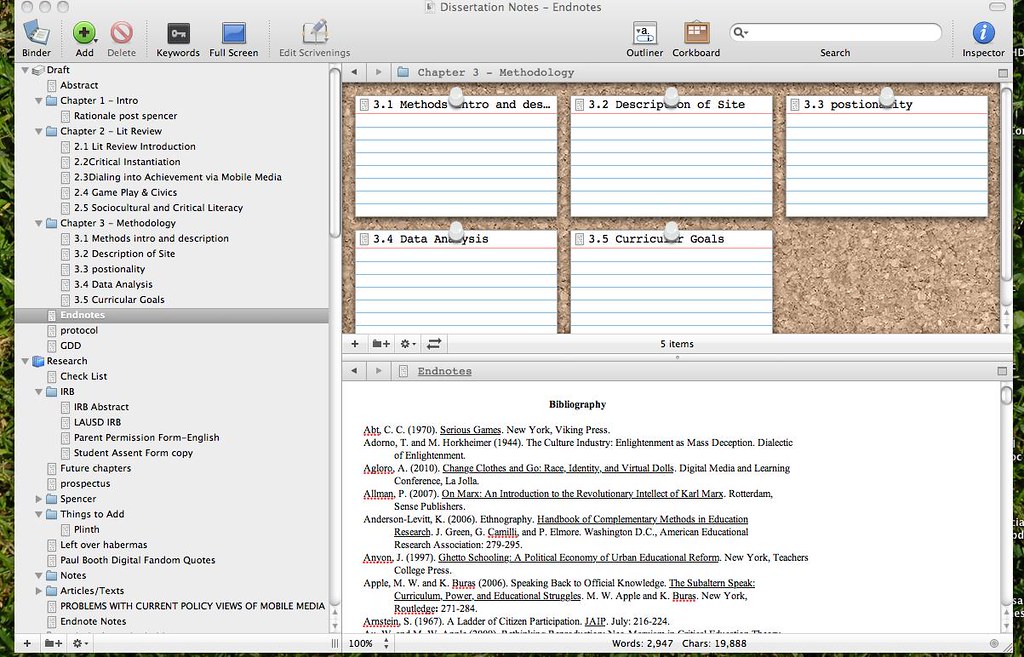
Just over a week ago, I defended my dissertation proposal for my Ph.D. Though I intend to more fully describe the proposal, my plans for implementation, and how you can be involved, I wanted to here describe the writing tool that I relied on. To be as blunt as possible, Scrivener is perhaps the best forty dollars I’ve spent in my professional career.

Through breaking down a larger document into smaller files, folders, and subfolders, Scrivener fits the ad hoc nature of my writing style. Frequently, I would find myself jumping from amending the proposal’s rationale to tweaking a few lines in the lit review to jotting out a section of the appendix. I started writing my proposal importing a handful of useful articles and a few paragraphs and papers I’d previously written that helped guide my writing. Scrivener allowed me to morph these scraps as needed throughout the months I spent writing the 80+ page proposal I ended up with.  For instance, I started the bulky literature review chapter with notes on the areas I intended to review. These were in a single text section. However, as these areas grew, I broke them into the five sections you can see in the image above. These too, in turn, were expanded to allow me to more closely focus on various nuances within the areas I was reviewing and collapsed later for fluidity.

Scrivener allowed me to expand and collapse text and folder as needed, move sections around, and keep many of my needed PDFs, images, and notes within an eye’s view. Being able to edit with two text windows open within Scrivener meant compiling my bibliography while writing, or looking at various drafts simultaneously.

Oh yeah, and it’s really, really easy to use. Pretty much everything I do with Scrivener is covered in this single video.

I also want to note that I don’t feel like I come anywhere near to utilizing the many features that come included in Scrivener. However, it significantly frees up my time between drafts and allows me to work quickly through larger documents (I’ve used it for most papers and articles I’ve written in grad school). It would be nice to see something Scrivener-like that becomes more collaborative (I really enjoy working with Google Docs with others, and can see Scrivener working well in this context). I definitely don’t get compensated for raving about Scrivener, and I paid for it (their ease with which they allow me to put it on the multiple computers I use is also appreciated). I get questions, occasionally, about the software I use when writing. I begrudgingly stuck with Endnote because I’ve already invested in learning its interface. Scrivener is intuitive and has become an essential component to my productivity.

[Note: A significant update to Scrivener recently came out. I have not yet looked into the additional features.]

NCTE Bound

So much to blog, but actual posts will resume in early December after some substantial deadlines are met.

In the meantime, if any readers are going to be at the NCTE Conference in Orlando this week, I will be presenting on mobile literacies on Saturday:

“NEW MEDIA, POPULAR CULTURE, PEDAGOGY, AND PRODUCTION IN URBAN CLASSROOMS”

2:45-4:00 p.m. Yacht & Beach Club/Asbury Room A

Also, I will be at the U.S. Department of Education exhibit booth (#209) for much of Friday, Saturday, and Sunday. Please stop by and say hello. I’ll be co-facilitating a few roundtables with teachers as part of my duties as a Classroom Ambassador; if you are in Orlando and would like to participate, please let me know.

Sorry for the delay. More updates to come soon: Kanye’s lessons for educators, Peter’s magical school desk, further negotiations of space, and spiders, Spiders, SPIDERS!

Waiting for Dialogue

There’s a lot of talk about Waiting for Superman: what it gets wrong, what it portrays incorrectly, what needs to be done. Having finally seen it, I actually can’t say I’m all that disappointed with the film. If anything, I see it as a tremendous opportunity.

Sure, I take issue with the ways that charters are lionized, unions are vilified, and lottery-losing parents are victimized in Waiting for Superman. However, as an educator, I can say I’m still genuinely glad this film is making headlines. I realize this idea may upset many of my colleagues, but I hope more people will see it. I hope they’ll walk out of the theater angry.

Scanning the credits, I noted that Waiting for Superman utilized a data set and resources I am not only familiar with but know and trust the researchers that created it. As such, it’s not that the film is menacing propaganda but more a gripping reminder of the ways that data can be framed to tell specific narratives. Of course, when such tales deal with the opportunities and lived experiences of young people across the country, the stories matter much much less than actual results.

I appreciate efforts like Not Waiting for Superman and I hope more people will be able to look at some of the more level headed responses coming out of the film. And frankly, the amount of funding that can go directly into classrooms as a result of the Donors Choose promotion with the film is fantastic. If anything, I feel like a lot of individuals are going to walk out of the theater and many will be compelled to visit the film’s web site, maybe click the Take Action tab, maybe even buy the more problematic companion text. And critical educators are going to stomp their feet and make this a debate when it should be a dialogue.

Here is a film that is helping create vitriol for the atrocities that are happening – historically – within classrooms. This is an opportunity to build coalitions around anger – not see the film as an attack but as an entry point for more dialogue and for action regardless of if you are pro-Waiting or pro-Not Waiting. Frankly, it would be great if a site like Waiting for Superman and a site like Not Waiting for Superman simply linked individuals to the exact same forum – everyone will be going to these sites for the same purposes: students.

Listening to Zaireeka: Participation, Learning, and Community Engagement

Sep 16, 2010

I was munching on a sandwich at one of my favorite local eateries reflecting on the random small accomplishments we often make during our off-track or vacation time. For some finishing recording an album, an early start on lesson planning, perhaps housecleaning long postponed. For me, I’m basically entrenched in pages of dissertation proposal writing. However, that hadn’t stopped me from setting goals regarding trying new cooking recipes, sketching out more time for creative writing, and making a dent in the to-read book heap (that continues, to this day, to grow like the weeds and wildflowers that pester the hedges and front garden of my apartment – perhaps another domestic area that should be added to the list of goals for the remaining month and change). In any case I realized there is something else I want do: I want to listen to an album.

No, not any album mind you – I mean I’ve got plenty to choose from (too many, depending on whom you ask). Specifically, I realized I wanted to listen to Zaireeka.

Released in 1997 by the Flaming Lips, Zaireeka is a four CD album – no, it’s not some epic prog-rock behemoth that goes on for hours. Instead of playing the four discs consecutively, Zaireeka requires – at least to be heard “properly” –  for all of the disks to be played concurrently. This, for several obvious reasons poses a considerable challenge. For starters, I don’t actually own four separate CD players (fine, with a couple of laptops, I suppose I do, but who wants to listen to the album through paltry computer speakers?). Secondly, the act of trying to sync and play four CDs simultaneously isn’t the easiest skill to muster.

To be clear, I think these challenges are my favorite part about the album. Since first purchasing my copy around a decade ago, I’ve only listened to the album twice. Yes, there are mixed-down versions pirated and readily available for download, but that defeats the experience – defeats the very idea – of Zaireeka.

Listening to the album becomes an event. Like today’s remix culture in which the lines of consumption and production are reversed, flipped, thrown out the window, Zaireeka predicts the relationship between artist and fan years before the (problematic) phrase “Web 2.0” ever traipsed out of Tim O’Reilly’s lips. At the same time, the conveniences of new media that make remixing and social interaction so easy for most today are utterly beyond the unwieldy challenge of playing four CDs together. You can’t listen to Zaireeka easily by yourself – you can’t slip on headphones and add it to your favorite playlist as you drive to work, shuffle around the grocery store, or walk the dog. It is a community event, one that is to be experienced as a group, even more so than a concert.

Having dinner with a friend recently, she mentioned the sense of feeling alone in a concert. Zaireeka is the frame for establishing and creating a non-digital social network; it is a network where participation and interaction is key. We laugh, nod along, and giggle at the odd noises and melodies that Wayne Coyne and co. enact with us.

I also like the notion that the process of participating with the album can utterly and beautifully fail. I remember on the two occasions I’ve tried listening to the album the numerous false starts and failed attempts to get the discs to correctly sync. It was a learning process and one that was bolstered by the shared interest in making the album “work.” The Flaming Lips were counting on us, after all.

Shortly after setting my sites on setting up a listening party for the near future, I found out that the 33 1/3 book series published a small tome on the landmark album. The book is a fun description and contextualization of the book. Like this post’s musings on the album, little groundbreaking revelation is offered about the album, but for fans of the Lips, it’s a text I found entertaining. The author, Mark Richardson, points out that recording for Zaireeka coincided with production for the critically lauded Soft Bulletin. Opening with the sweeping orchestrations describing “Two scientists […] racing for the good of all mankind,” the album’s hopeful exuberance captures best the delicate and boisterous act of becoming a co-creator and acting out another performance of Zaireeka.