“‘Cause everybody hates a tourist, especially one who thinks it’s all such a laugh”

So in my occasional reality TV binging, I stumbled across a monstrosity. It’s on Fox (surprise!). It’s called Secret Millionaire and it makes me genuinely uncomfortable to watch. Of course I plan to use it in my classroom!

The premise is simple: get rich, privileged folk to mingle with those in “extreme poverty” for a week and then give to those individuals that they feel are most in need. Here are the actual lines displayed at the beginning of each episode with a couple of quotes from one episode:

For one week So and So will live undercover in poverty.

They will leave their possessions and identities at home.

People will be told that So and So are involved in a documentary about poverty.
They will have to survive on a welfare budget of $107.

“I’m really nervous about the story I’m going to tell people because it’s not true. I am a multi-millionaire trying to pose as an average Joe.”

“I guess my biggest fear is about safety.”

Maybe it’s the “scary” and the “sad” music that’s played when these millionaires first visit their temporary new homes. Maybe it’s the way that the poor are a sob story and two or three families become aw-shucks-feet-washing-idolaters for deceitful benefactors with open checkbooks. Maybe it’s the horrendous, stereotypical formula of the ghettoized neighborhood that reveals a few beautiful gems that deserve reward.

Part of why I’m fascinated by reality television is because it’s so far away from actual everyday experiences. There are these amazing fictions being constructed in the mundane that are interesting to look at. I like knowing about this microcosm of infighting on some island in Survivor. Or if that hem will hold on Project Runway. Or if the flight will be booked on the Amazing Race.* The problem is, I feel really uncomfortable watching the caricature of “poverty” that is edited for the prime time Fox audience. Suddenly, this reality feels a bit less familiar and a bit less lighthearted.

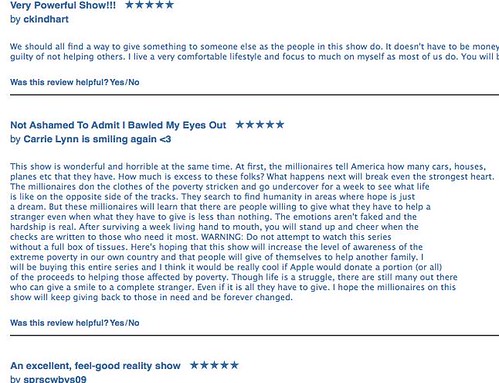
Looking at the show on iTunes (I’m downloading the episode where a husband and wife dare to live in Watts for a week for class discussion), I’m even more concerned by the types of comments made on the show:


We’ll see what the kids of South LA think about Secret Millionaire next week.
*Speaking of the Amazing Race, after seeing Slumdog Millionaire (another Millionaire?!?), I’m pretty sure that the reason the Amazing Race spends at least two episodes in India each season is because it’s easy to show cultural practices that look “crazy” to us westerners. Similarly, the sheer density of the cities used makes even us Angelinos gape in amazement at the insane life “over there.” I’d imagine I’d have as visceral a reaction to these episodes (and their constant reliance on the country as the “crazy country” trope) as I do to Secret Millionaire if I actually lived in Mumbai.

When Critical Goes Too Far: Let’s Discuss

This started as what was going to be an email to a colleague. However, I’m thinking that posing this as a discussion maybe a more fruitful dialogic exercise.

My situation is as follows: I have a class of upstanding and exceedingly bright individuals. These students regularly point the way toward large-scale change but hesitate at taking the small step (humongous dive?) toward action. In any case, I recently used the song “Police State” by Dead Prez as the beginning of a writing assignment. It’s a song I’ve used in the past and one that kids generally enjoy (though hip-hop is not at all the apriori musical preference of my students). However, after the experiences and reflections of the lockdown, of critical analysis of the election, and after a lengthy review of Critical Race Theory, I think something snapped … in a good way. The kids are way engaged and on-board the Critical Theory train. They regularly use the word “proletariat” (as it’s mentioned in the song) to describe the conditions of the campus. Students discuss if racism or classism is the bigger issue at hand. A student is writing an essay talking about how Obama is going to be a part of “the problem”.

So on the one hand, I’m thrilled – the kids are vocalizing their concerns from a clear, “Critical” (with a big “C”) stance. They’re bringing up their own topics for our daily discussions. They looked at this video, for instance, and were able to empathize and critique the key arguments made. One student is providing the class with additional resources, such as this video he’s asked to screen tomorrow.

And so my query for you is about this: It may seem odd, but I’m worried that my kids are a little too critical. They are heading toward being too one-sided in the dogma they endorse.

I plan to rectify this; I have had some teaching peers preaching the concepts of critical pedagogy but not quite executing them. Instead, I see their students as mindlessly unengaged in their thinking due to the totalism these “progressive” teachers impose. So, that being said, I have specific ideas on how to balance the theoretical base of my students. However (and although I will likely only hear from one or two of you), I’d like to open this post up as a collaborative space for discourse. Do you see a need to fix this situation? How would you approach it? What’s your take on the process of critical discourse in your classroom?

(As for the  picture – here are some anthropologists of the future – specifically the year 2158 – doing fieldwork and observations at the ancient site of Manual Arts High School circa 2008. Taking notes, these anthropologists were asked to stay as quiet and reserved as possible as the natives do not like being disturbed.)

“An Alchemical Transformation”: J.S.G. Boggs and the Convergence of Art and Money and Pedagogy

The reason you need to read Boggs: A Comedy of Values is because it changes the way you see the world. That’s as simply as I can put it. It’s not a new book. It’s a slight tome, under 150 pages of narrative juice. However, the book and the artist at the heart of the account are too entertaining to simply pass on.

Before jumping into why J. S. G. Boggs matters to you, I should probably say that Lawrence Weschler is one of my favorite non-fiction writers. He’s written about my favorite places in the city and his series of convergences strike at the heart of what the Beyond Pedagogy reading group was striving for. Weschler knows how to tell an entertaining story, even if it is occasionally a cerebral one. When I think favorably about the work in the New Yorker, it’s often that its one of the few mainstream places for long-form journalism to spread its wings; I think of that Professor Seagull account, of the early ‘90s two-parter on surfing with “Doc” in San Francisco, of Trillian’s description of Kenny Shopsin, of the magic that is Ricky Jay, and I think of Weschler’s work at large. As a writer, it was these long pieces that influenced what I wanted to write and how I wanted to approach a story. I also realized that my limitations in terms of patience and – frankly – skill in execution meant that such efforts should be largely left to more focused scribes. Nevertheless, sometimes while listening to the manic squabble of Cliff “Ukulele Ike” Edwards, or maybe witnessing the frantic scratches for sound at one of the infinite Jon Brion shows I’ve attended, I imagine great unfolding profiles about looming personalities I hope to read (or, as Zappa said, “He not only dreams imaginary guitar notes, but, to make matters worse, dreams imaginary vocal parts to a song about the imaginary journalistic profession”).

With that out of the way, here’s what you should know about Boggs: he’s an artist. Mainly, he creates drawings and paintings of and about money. As a result, he’s been arrested and involved in numerous lawsuits for counterfeiting currency: U.S. currency, British pounds, Australian notes.

Actually, these drawings aren’t even what Boggs considers his art. Instead, he’ll take a drawing of, say, a ten-dollar note (of course only drawn on one side of paper) and attempt to “spend it.” For instance, he might take it to a restaurant and see if his meal can be bought with the ten-dollar picture. In exchange, Boggs expects a receipt and any change left from the transaction (an $8.45 meal would require the person involved in the exchange to actually pay Boggs $1.55). This transaction and its verifying documents is Boggs’ art. In the art market such Boggs paintings often go for thousands of dollars, but Boggs prefers making these transactions with people that aren’t familiar with his reputation.

Reading about this process was thrilling. I started thinking about long-term implications this can have on classroom practice, on replication and authenticity, on the palimpsest-ual allure of spending images of those things that are to be spent (palimpsest being a word I’ve been returning to in my thinking of late). I’m still thinking through these ideas and cannot offer any new insights, but Weschler offers a useful entry point:

Boggs had almost accidentally stumbled upon the terrain but then decided to pitch his tent there along the fault line where art and money abut and overlap – and his current work has definite ramifications in both directions. The questions it raises start out as small perturbations: How is this drawing different from its model (this bill)? Would you accept it in lieu of this bill? If so, why? If not, why not? But they quickly expand (as you think about them, as you savor them) into true temblors: What is art? What is money? What is the one worth, and what the other? What is worth worth? How does value itself arise, and live, and gutter out?

Later in one of the book’s closing sections, Weschler describes one of Boggs more ambitious extensions of his conceptual art. This too allows me to consider the role of participation and teacher-learners in a Freirean frame. It’s all too tempting, I suspect, to write off what Boggs is doing as purely theoretical or art-practice only. I am, however, now reviewing the education terrain in my class because of silly thumbprints and five-dollar notes in the Boggs-o-verse:

… Boggs informed me one afternoon toward the end of 1992, he’d decided to raise the ante considerably. He was about to embark on what he was calling “Project Pittsburgh.” He had fashioned an entirely new edition of Boggs bills – brand-new drawings in denominations ranging from one, five, ten, and twenty dollars on up through ten thousand. He’d laser printed a million dollars “worth” of these bills – enough to fill a bulging suitcase. Starting on January 1, 1993, … he was going to try to spend these bills in his usual fashion, by getting people to accept them knowingly in exchange for goods and services; only this time he’d be adding a new twist: he was going to encourage anyone who accepted his bills to keep them in circulation. This time, he was using the back side of the bills as well: an elaborate lacework design filigreed around five empty circles. Anyone accepting a bill was to immediately press his or her thumbprint into one of the empty circles (“just like being arrested,” Boggs noted, with evident satisfaction), and the bill would not be deemed to have completed its life cycle until it had changed hands five times, acquiring a full complement of thumbprints. “I want others to share in the fascinating experience of trying to get people to accept art as face value,” Boggs said, which expansive generosity. “And I, in turn, want to share in my collectors’ experiences of trying to track these pieces down.” Be that as it may, the practical consequence of Boggs’ experiment was that he was going to be creating five million dollars of value out of nothing – an alchemical transformation likely to provoke the Internal Revenue Service every bit as much as the Secret Service. (Boggs assured me that he stood ready as always to cut the IRS its own fair share of Boggs notes.)

As much as I feel inept about art and the art world, I’d be interested in applying these philosophical constraints to an educational cohort. From experiences during the Black Cloud game, it’s clear that the in-roads that art clears toward learning are ones that students access differently than what paths may be taken in traditional English classes. More than anything, projects like Boggs’ are about the individual’s experience. About being un-situated (in some sort of corollary to Lave and Wenger)and building a re-situated understanding of the world around you.

Rock Replica


I’ve been meaning to write about this for a while and it’s gotten lost in the chaos that is the paper grading/paper writing shuffle (my dancing shoes were a but scuffled and I’m now getting my rhythm back). In any case, the picture above is not a picture of my attempting to slay at Rock Band. Instead, it’s a photo (and a blurry one at that!) of what I saw while watching MTV two weeks ago. That’s from a broadcasted Rock Band competition.

In the past, I’ve written about MTV’s strategies to move toward a more participatory model of entertainment. It’s interesting to see the simulacrum of this newer model of participation. Yes, you can still go online and interact with the contestants, discuss the show, and offer other online splatter to the digital mess. However, let’s think about this… Music? Check. Television? Check. Except that, oh yeah, no one is actually playing a real instrument. Sure, the drummer is drumming in time and the singer is fluctuating his or her vocal cadence appropriately (and the guitar and bassists are – like – thumbing that bar-button at the right time), but is there actual musical talent in this? Not necessarily. In any case, I’m fascinated by this latest development. It reminds me of the “Replica Replica, After W. R. H.” component of the Machine Project Field Guide to LACMA.

On a final note, you’ll notice from a few links in this post – like others – that I’ve been frequently linking back to my own previous posts. This isn’t necessarily a tactic of self-promotion or some weird meta-ones-up-manship. Instead, I’m interested in how I can network my own ideas together a running kind of dialogue. I’ve come to accept that I don’t write linearly (to this respect, adopting Scrivener to complete this quarter’s writing projects was an absolute life saver!). I remember taking the four-part English CSET exam while getting my teaching credential. Over the two or three hours I spent taking the test I randomly shuffled between the four different test booklets and corresponding answer documents. I recall clearly (which for me is a rarity these days!) finishing all four tests within minutes of one another: adding a sentence here, bubbling in over here, crossing off another option in this booklet, etc. I know that research proves one cannot multi-task. However, I’m not sure I can even uni-task all that well … parsing my thoughts out one blog post at a time and finding the line (thin as it may be) back to point of origin may be the best setup going for me at the moment.

Discussing Macbeth Today

Me: Please make sure you’ve underlined the passage: “For none of woman born shall harm Macbeth.”
Student: Mr. Garcia, this has nothing to do with the play, but what is up with that pregnant man?
Me: … Actually, that question has a lot to do with what we’re reading…

And so began a great in-class tangent about how the progeny of the pregnant man pose a serious threat to Macbeth, just like his foe Macduff. Also covered in the discussion: differences between sex and gender, the significance of the play’s second apparition appearing as a bloody child, and speculation about if the pregnant man has a “peter-deter*.”

*Student term, not mine.

On the Glory that is The Commitments

“What kind of music are we going to be playing, Jimmy?”
“We’re working class, right?”

“We would be if there was any work.”

“So, your music should be like where you’re from and the sort of people you come from. It should speak the language of the streets. It should be struggle and sex and I don’t mean I want to hold your hand until the end of time and mushy stuff like that…”

“What kind of music says all that?”

“Soul.”

“I am the disordered creator of the most obscure routes, the most secret moorings”: On Fear and Letter Writing

You know how everyone has these insane little fears that make no sense whatsoever to anyone other than themselves? I’m not talking like a fear of spiders or a fear of clowns or anything like that. I’m talking more about idiosyncratic/ideosyncratic (yes, I invented that second word. No, I won’t define it).

In any case, one example would be this weird fear I occasionally have that my joints will freeze up and just like become paralyzed. For instance, walking from car to kitchen with a ton of groceries, my fingers could be trapped in this weird gripping apparatus of plastic bag handles (yeah, I know its bad for the environment, but this is hypothetical so bear with me). What if, after finally resting the bags on the ground, I find that my fingers are still in this gnarled position of paralysis? Forever? A rather silly, inane fear, right? Something like that.

Anyway, one of these “little fears” I’ve had lately is of the loss of the art of letter writing. I’m not talking about some sweeping account of letters as only a group like the New Yorker would predict. Instead, I’m imagining that the practice will just slowly fade out of favor. With Blackberries (which I suspect get an overly bad rep from folk like me) and email and texting and hands-free cell phone use and walkie-talkie chirps (“Where you at?”) and –gasp- blogging, is it really necessary to actually write now a days? Is a response even necessary beyond a simply affirmation or confirmation of time and location?

I used to write the hell out of emails to friends. Real long and rambling and drunkenly enthusiastic in tone or overly ambitious in candor. I would feel like I was having fun writing up these diatribes. To some, these were a one way conduit of information and I was rather selfishly imposing my words on unassuming readers browsing through their inboxes. For others, these would become a part of a network of exchanges. That’s when sparks would really fly. (I’m again reminded of what I continue to bring up as “magic” in a non-David Blaine, non Western kind of way.)
Case in point, some of my favorite things to read are letters. I get a thrill out of these soliloquies set on paper. Of course, they’re not soliloquies, all letters are intended for someone. They are more like monologues when read unilaterally. However, aside from when they are bound into big collections of one author’s letters, all letters inevitably have a recipient who then becomes author and author becomes recipient ad nauseum. The key here is that when letters are paired with responses, they – together – become dialogue. It’s the convo that contains possibility. I think this is why I’m so thrilled about slowly consuming the Elizabeth Bishop/Robert Lowell bound book of correspondence.
(And as a major diversion, it’s worth noting the use of “consuming” here. Anyone who’s seen my bookshelf and my music shelves and film storage will attest that I’m something of a terribly overwrought consumer – though I’m partial to the notion of an archivist. In any case, let’s think about what it means to “consume.” The proper way to really partake in a book or a film or musical composition is to consume it. Kill the author in a way that will make Barthes smile and make the work one’s own, frame-by-frame, page-by-page, Measure For Measure. A rather one-sided –and delicious – dialogue if there ever was one, eh?)

So I come back to this trivial fear. Sure, I can always be a part of a dying breed that still do the letter writing thing – like a hopeless vinyl (and now, to an extent CD) fetishist. It’s scary to imagine confining oneself to 140 characters all the time, despite my fascination with Twitter and texting. I remember deliberately being interested in the form of the epistle. My handwriting never developing much beyond a gnarled scrawl  – I suspect writing both left-handed and right-handed as a child didn’t help develop this foreign thing called penmanship – I never really venture far from a keyboard when it comes to letters. However, printing letters on yellow tablet paper, on pages from library books (oops), and whatever else was lying around helped me better grasp the possibilities of the letter. I distinctly remember a brief period of typing letters on big manila envelopes sometimes adding an additional letter inside the envelope other times the envelope acting as nothing more than a glorified postcard to the bemusement of mailmen and women.

I think similar experiments will yield value and understanding in the digital age. Periods of extraneously long subject headers, toying with the CC and (shudder) BCC field also pock a blemished emailing career.

Ultimately, however, I think the value of the digital letter will be of access. Granted, it’s all too easy to discreetly forward the screed received in an inbox. However, what about open letters as policy and not as exception? The sole versus between Daye and I, I think was a worthwhile dabbling in such a project.  On the other hand, however, there is certain glee in cherishing, rereading, connecting with a letter in a wholly and completely personal way. And not simply content of a personal matter but of content in which one connects in a personal manner (hopefully this distinction doesn’t read as subtly as I fear it might).

And while there is no Mr. Henshaw to which my students today connect with, we’re regularly practicing our letter writing skills.

I’ve been feeling reinvigorated and reminded of the value in letters (both those joint-connecting phonemes and the actual literary medium). Hopefully, like paralyzed joints, this inane fear will remain just that.

[Reflecting on this, I reread the rather fun series of exchanges conducted with Daye (mentioned above). Perhaps the days of the versus project will return with a cargo cult following…]

Jaywalking in the Global City

During the drive to and from turkey-related festivities this weekend, I was able to catch up on some podcasts. Aside from the splendor that most of us know at This American Life, I’ve also been listening lately to stories from the Moth.

While driving, I listened to writer Andy Borowitz talk about the misery of writing for the television show The Facts of Life. And while the story as a whole was fun, there was a portion at the beginning I want to point out. Borowitz makes excuses for why he wrote for what he refers to as “the worst television show ever produced.” Specifically, he says: “I was broke. I didn’t have a car. I was taking the bus, which in Los Angeles is akin to eating out of a dumpster.”

The audience chuckles knowingly.

I hate to be a buzzkill, but the humor from which this joke comes from is unsettling. I don’t fault Borowitz or the audience; they are recognizing the societal norm of the city – the inherent and necessary capital that a car represents.

See, nearly all of my current students are 16 or older. I could count the number of students that have or regularly borrow family cars on one hand and still be able to throw out scissors in a friendly game of ro sham bo (whether these students are driving legally is an entirely other discussion, considering some of them are considered undocumented). My classroom isn’t an exception or an outlier in terms of car ownership in this part of town.

The types of people that have the tech know-how to regularly seek out and listen to podcasts or have the free time and extra cash to go out to a theater or club to catch live entertainment are certainly going to be car owning Angelenos. However, let’s be aware of the fact that there is an entire population in this city that is denigrated in this humor. I am reminded of a text I read while working on my Masters several years ago. Pauline Lipman’s analysis of the “dual city” emerges from a closer look at a seemingly harmless joke.