
“What is a reflection? A chance to see two? When there are chances for reflections, there can always be two–or more. Only when we are everywhere will there be just one.” – Log Lady
“What is a reflection? A chance to see two? When there are chances for reflections, there can always be two–or more. Only when we are everywhere will there be just one.” – Log Lady
I have previously written about my regular practice of having students evaluate me as their teacher at the end of each term. In an effort to encourage others at Manual to do the same thing, I am posting the entirety of the 19 evaluations I received this year. I realize this sample size is smaller than in the past. However, with the number of crossover students taking both my 11th and 12th grade classes, this number represents approximately half of the individual students I currently had enrolled. The prompt I asked students to respond to, once finishing their final was:
Evaluation: This is the end of your 2nd mester of English, you will not have any more English classes this year. Please write down what you think could be most improved about this class for future students. What do you think was least helpful in your development as a reader, writer, and critical thinker? What do you think was most interesting or most helpful? How can Mr. Garcia be a better teacher? Do you have anything else you would like to say? Please do not put your name on this evaluation.
I’ll also add that since many students were pressed for time, polishing off their final writing assignment, this too made the sample size what it currently is – something I will actively attempt to improve the next time around. I occasionally hear of other teachers wary of evaluations or visits from administrators or other visitors. My feelings on the matter are that my classroom has an open door for anyone willing to be a part of our class community. That being said, I hold myself most accountable to those I consider the true “boss” in the Ed. system: my students. I think if we’re really going to value their educational needs their voices and concerns should be listened to on a regular basis.
All of the samples can be found as a Word doc here. While I’m not attempting to offer any kind of rationale for the positive or negative statements some students made, I did want to reflect on some of the things I’ve learned from these evaluations. Yes some of these are positive and some are negative, but the point of this initial half of the post is to really offer up a transparent view of these evaluations. [Since this probably isn’t of interest to everyone, simply click after this section if you’d like to see these reflections.] Continue reading
Glenn Goldman, owner of Book Soup, passed away yesterday. The two years I spent mainly wasting time while on the payroll at Book Soup were fantastic. Although student teaching (and later teaching/completing my Masters), Book Soup was a useful way to get away from the world of secondary education if only for an evening or weekend shift. The newsstand, in particular, was an eye-opening locale to work at. I met some amazing people & read some amazing books while at The Soup and I’m grateful for the opportunity that Glenn gave me (with a call for an interview on Halloween, no less).
Though it’s not exactly the most lucrative of markets, I do hope that Book Soup perseveres.
I’ll stand rank-in-file with other bibliophiles about the graceful perfection that is a book’s form. It – in its compact design and wealth of stored, permanent (read-only) memory – is a supreme and methuselah-istic technology.
That being said, the playful aspects of experimental literature are provoking in the way they push this form beyond the typical confines of the bound novel. Yes, the plethora of electronic literature is where most people suspect literature to move toward (Hayles’ latest book – both bound and digital – likely the best source for work on this). However, there’s something to be said for the tangible nature of the occasional experimental text. As such, here are two recent works that I’ve been fascinated by:
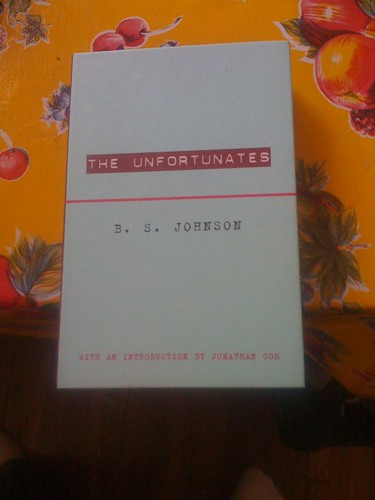
The Unfortunates by B. S. Johnson arrives in a box, though it looks unremarkable on the shelf (the side of the box acting as spine of a “regular” novel). However, upon opening the “book” the contents and their instructions are revealed:
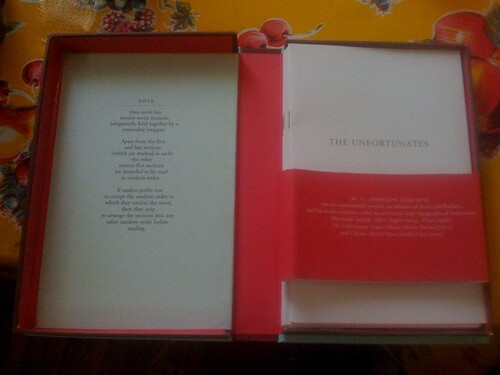

[Note: This novel has twenty-seven sections, temporarily held together by a removable wrapper. Apart from the first and last sections (which are marked as such) the other twenty-five sections are intended to be read in random order. If readers prefer not to accept the random order in which they receive the novel, then they may re-arrange the sections into any other order before reading.]
After reading Johnson’s novel, I’ll say I was underwhelmed only by the fact that the book did exactly what I hoped it would; I felt like I was thrown into the random, haphazard way that memory unfolds and takes hold. I could empathize with the method but still felt like the story itself was secondary to the experiment. Regardless, there’s a wonderful bio on Johnson that I’ve been plotting to read sooner than later.
On the opposite end of the extreme, Correspondences by Ben Greenman is such a lavishly letter-pressed trinket of a box that I fret doing the kind of serious reading that has crippled many a text that has come across my path.
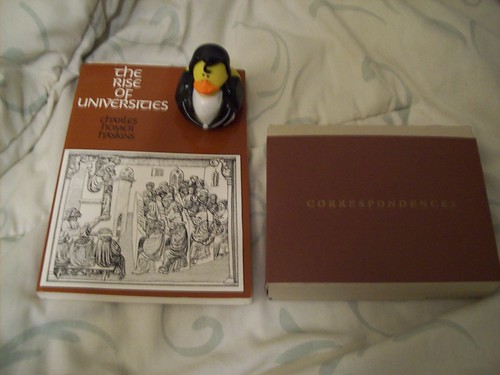
Correspondences next to Greaser Duck and another book for size comparison.
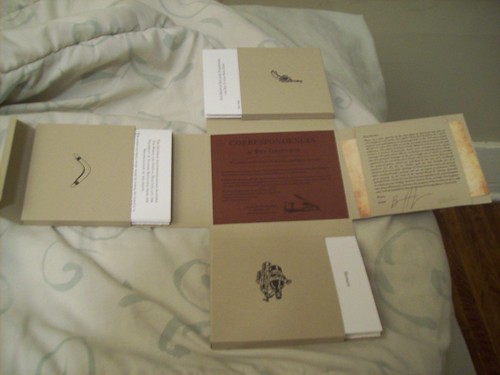
Apparently limited (mine being numbered 151 of 250), Correspondences includes several stories printed on the text as well as folded on pamphlets. Unlike Johnson’s text, Greenman’s makes you aware of the object as you relate to its contents. I think this combination is what I find as a portal toward more organic experimental literature (I think, for instance, of the way House of Leaves, by the simple dimensions of its cover is literally a text that does not fit within the bound book – a realization you make by holding the paperback).
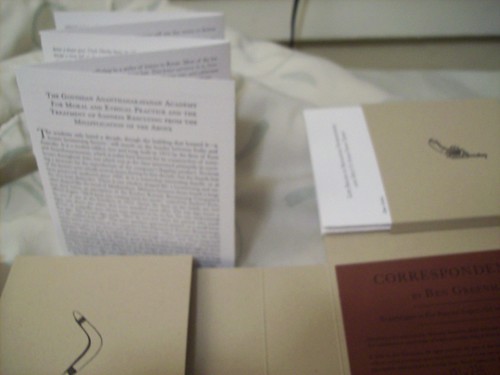
And while it sounds like future editions of Correspondences will be printed (likely in a more traditional form), that version’s text is in our hands (figuratively … and maybe literally). The story “What He’s Poised To Do” is an incomplete text. A series of postcards help build the links between the elements of Greenman’s text. However, these postcards need to still be written … by us! Though the Correspondences box comes with its own sample postcards, we are invited to add to the fiction that Greenman has started. I’m interested in using this in my classroom. Maybe Greenman has a few collaborators? Maybe one of them is you?

Yes, I realize that McSweeney’s has done several issues of their Quarterly in boxes and other shapes, including something along the lines of the way Johnson incorporates chance into his work. However, I feel the above two texts are exemplary. There’s a feeling of commitment by the author when presented with an entire work by an author in an otherwise unusual form. Worthwhile additions to the growing shelf of BSRAYDEKWTDWT.
I was going to do a top ten kind of list for the year but realized that most of the things listed would be obvious. As such, I’ll offer a few words on my year in reading and listening – a self-indulgent activity afforded by an already self-indulgent blog.
There really couldn’t have been a book atop my list that wasn’t Infinite Jest. I can’t remember spending as long as I did reading a book in the past. A surreal year to read the book, the loss of DFW framed the last third of the book in a more profound, vivid lens through which to read the reflections on depression.
I’ll also add that the graphic novel Robot Dreams, though wordless and typically advertised for elementary and middle-school aged children was still one of the other books that made a big impression on me. Following along with the election politics in DMZ was also a timely highlight throughout the year and the expected conclusion of Ex Machina this year will be the anticipated comic highlight.
Lastly, as far as music for ’08 goes the likely suspects would have rounded out any list I’d have made: the Walkmen, Jon Brion’s score for Synecdoche, New York, and that Lil Wayne album (no, not proud of this one) were played on a constant basis. However, perhaps the unsung hero of my ’08 listening habits is Future Islands: although the band made less than a blip in the press, their album, Wave Like Home is the sea shanty anthem that I whole heatedly blast during my commute between the opposing shores of Manual Arts and the doctoral program. I also became a big proponent of all things King Khan and BBQ and continued purchasing way more Acid Mothers Temple and tropicalia CDs than I could possibly have room for. Still waiting for the Tropical Revolution to take hold here in Los Angeles. As far as ’09 is concerned, the forthcoming Animal Collective album is by far one of the best things I’d heard all year.
Next year should be a good one: I’ve decided to participate in “National Reading 2666 Month” (I actually started the first volume while in the Bay, but probably won’t finish the final volume until Winter Quarter is over). There will be a new Geoff Dyer book, a new text by Sir Ken Robinson due any day now, an Ishiguro collection, and more than enough grad school texts to get in the way of otherwise leisure reading.

On Monday, I spoke briefly as part of a panel titled “Humanities 2.0: Participatory Learning in an Age of Technology” at the MLA conference in San Francisco. Along with Black Cloud collaborator Greg Niemeyer, the other panelists included Cathy Davidson, Howard Rhiengold, Todd Presner with Zita Nunes chairing the panel.
In addition to getting to hear updates about other MacArthur Digital Media and Learning Competition winners’ projects, the panel explored what kinds of educational opportunities are either afforded or compromised by technological advance (a distinction established by one’s individual disposition toward things like social networking … see below). Howard Rheingold (pictured speaking in the background above, his hat in the foreground) gave a useful overview of his Social Media Classroom. Meanwhile it is exciting to see the possibilities for collaboration with Todd Presner’s Hypercities mapping project. Aside from the collaborative aspects, I’m seeing direct in-classroom use with Hypercities; it is accessible enough for my students and can fit in nicely with the graffiti mapping they have done in the past.
Primarily, the time in the panel Greg and I had was spent discussing and describing the work done via the Black Cloud game. However, my thoughts wandered throughout the discussions. From a critical perspective, I imagine Humanities 2.0 as an opportunity to get things right for our students. In imagining a 1.0 version of the Humanities, I imagine a privileged topography not all that accessible to my segregated students of color. In this sense, I would hope for Humanities 2.0, and its laborious steps toward the embrace of technology, to actually treat these students respectfully. Literally, it is an opportunity to restore humanity in the Humanities. I say that not to be pedantic but from a Freirean critique of disenfranchised, static learning models. In her opening remarks, Cathy Davidson helped expand the notion of Humanities 2.0 beyond simply an endorsement or utilization of technology; she discussed “humanistic attention to race, class, and gender.” For us to think of a more inclusive Humanities, H2O will need to start here.
A few days prior to the conference, I sat in an airport plagued by holiday travel conditions and read two short texts, both appropriate to the discussion of the H2O.
Walter Mosely’s Life Out Of Context helps expand notions of genre and accessibility for the Humanities. For instance, Mosley turns to the often-overlooked value of science fiction as a place of possibilities:
This form of fiction has many different ways of pulling us out of our everyday mindsets and putting us into contemplative modes. For instance, a book of this sort might move your consciousness fifty years into the future or a hundred years back. From that point of view, we can look back (or forward) at ourselves with the imposed objectivity of a removed narrator.
In discussing educational inequality with my students, our community of learners often gets to a place of increasing frustration and finds difficulty finding the steps toward actually changing the reality of unequal schooling. The notion of projection is one that I think helps unravel the limitations within the present day. The Ecotopias that the students created at the end of the LA iteration of the Black Cloud, for instance, remind students about actions they need to take now in order to realize their role as agents of change.
The second text read in the Burbank airport, Charles Homer Haskins’ The Rise of Universities traces the 12th and 13th century lineage of the modern-day higher education system. An entertaining overview, I am drawn to the role that students were placed within these early academies and parallels to their role in schools today. Describing the text of a student manual for early German university students, Haskins writes:
When the young man arrives he registers for Ulm; his parents are in moderate circumstances; he has come to study. He is then duly hazed after the German fashion, which treats the candidate as an unclean beast with horns and tusks which must be removed by officious fellow-students, who also hear his confession of sin and fix as the penance a good dinner for the crowd.
As we generally think of the networks of people and information made more readily accessible when discussion all things 2.0, I continue to dwell on the fact that this gate continues to remain shut for my students (I realize this issue is making me sound like a broken record on this blog); their cell phones and MySpaces the horns and tusks to be removed by “officious” schooling professionals. Yes, the Black Cloud members temporarily jumped over this obstacle via Twitter, but I get nothing but raised eyebrows and annoyed huffs when discussing cell phone use and social networking with the skeptics in the secondary education world.
A general curmudgeon-ish comment that was voiced at the end of the panel was in regards to the lack of “critical thinking” that is sacrificed in exchange for online, social activities. That is, ‘Those blogs and forums and videos and images are neat, but kids aren’t really thinking all that hard, are they?’ I get frustrated by comments like this as they feel like they come from a person only limitedly, skeptically experiencing what these new medias are offering. A brief analysis of this discussion as it took place in the panel can be found here. Jame Paul Gee’s breakdown of Pokemon in Situated Language and Learning helps demonstrate the complex systems and thinking involved by video games and networking and all of those things some educators see as wastes of time. Similarly, when addressing this question at the MLA conference, I mentioned that the educational system in general – at least in my context as a high school English teacher – doesn’t promote critical thinking skills. Standardized testing, high school exit exams, and the general low expectations our school system places on students encourages a minimum of critical thinking.
Finally, another commentor at the panel mentioned that in a college course she taught, she found limited success in implementing forums. Students simply weren’t posting regularly without it being a course requirement. This, too, is a challenge answered by Gee. Forums are “affinity spaces” for a community with an invested interest in furthering expertise. As a student, I’m not going to post on a forum unless I have a personal interest in giving and taking away from the discussion. Even if your course is about popular culture students will not participate unless they are actively engaged in the material. This is one of the key problems with the occasional classrooms I observe: just because you, as the teacher, are bringing in hip-hop or a popular TV show does not mean your students are going to engage beyond the minimum amount that they do on a regular basis. Unless students see themselves as participants with a specific purpose and motivation, forums, blogs, and other social networking becomes simply another hoop to be jumped through.
McKenzie Wark points toward the “Hacker Class” as including anyone involved in creating intellectual property. I imagine this as the critical and “legitimate” route for my students to become participants in humanities and academia in general. However, I also think of the multiple definitions entailed in “hack”: to gain both illegitimate access to something as well as to be seen in a pejorative light as creator of lowbrow work. Sure, both of these are definitions beyond the intentions of Wark’s original label. They are, though, useful in seeing the way a larger stream of poor students of color will be viewed in the post-secondary landscape.
Having maintained a MySpace page for my students for nearly three years at this point, updated a blog on an occasional basis, toyed with twitter, and tinkered with wikis, I’ve been long overdue to join Facebook. My reluctance, primarily, comes from the fact that Facebook still hasn’t tipped with my students. They still rely on MySpace – only one of my former students has been spotted on the site. That being said, it feels way too hypocritical to be spouting off about the values of social networking without actually … you know dabbling in it. I’m already interested in the possibilities of “groups” on Facebook – made one for future class use. Of course, Facebook is blocked by our district, but we’ll find a way to get kids on the site.
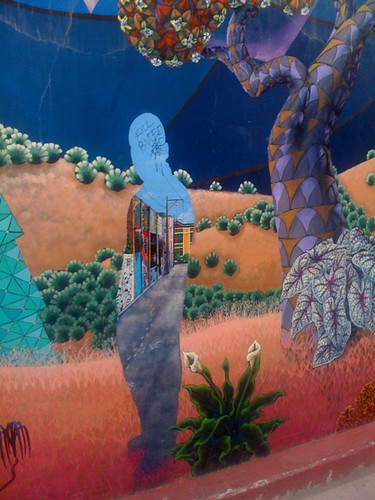
“But shapes on a painting are just shapes on a canvas unless they start acting on each other and really, in a sense, multiplying. A good painting has a gathering, interactive build-up. And the good artists all knew it, too. That’s what a good Vermeer has, or a raku cup, or a Stonehenge. And when they’ve got it, they just jump off the goddamn wall at you. They just, bam!” – Robert Irwin
May your holidays be filled with dancing!
“The game as I conceive it,” Knecht once wrote, “leaves (the player) with the feeling that he has extracted from the universe of accident and confusion a totally symmetrical and harmonious cosmos, and absorbed it into himself.”
– Magister Ludi, Hermann Hesse
Abstract
This lengthy document begins with a discussion of the political act of conversing. It offers a meek-mannered confession and detailed explanation of said confession. It reviews the interactions of a reading group and then veers into another more stodgy confession: that the entire document is actually a call to action. By the end of this document, readers are encouraged to continue the work that stands Beyond Pedagogy and to pick up pens (or pound at keyboards) to find authentic educational change beyond the unhygienic standing water language pools that we so constantly wade through in today’s professional development models. You’ve been warned.*
*For those wary to jump into the entire document below, the Beyond Pedagogy group is now concluded. Future iterations of similar groups will commence in the near future. Those individuals interested in participating are encouraged to contact me (I’m not necessarily organizing new groups but can encourage and connect interested participants).
On Conversation
There’s something to be said for conversation removed from explicit purpose. That, in sitting down with a regimented agenda, a series of protocols beyond social niceties, and a timeline, there is a very definite loss in productivity. This may sound counterintuitive, however, think about the way a conversation unfolds with colleagues at lunch, in the car with a friend, over wine and starters at a restaurant; our natural inclination is of waywardness. We – as dialoguers – meander from point to point. Yes, these examples are ones without specific goals set in mind; however, they are the ways we develop, critique, and experience understandings and ideologies of the world around us.
Further, it is important to point out that such conversations, though void of standard meeting procedural paraphernalia, are not without vision. For all of us, a conversation is a moment of contention, of ideological territory being sniffed out, a moment of invested interest. We gain and procure through dialogue – a deafening yet invisible economy. Like the act of teaching, each discussion, each joke passed, each question echoed, is a political act. In voicing an “um,” a “like,” an ill-tempered or sardonic guffaw, we put ourselves on the line for judgment.
This rumbling of verbosity leads me to “an overwhelming question” (to quote Eliot): “Why not?” That is, why not remove the walls and pillars of organization from professional discourse? Even temporarily? As mentioned, we are all clearly invested in a common interest that arrives en masse on our campuses each morning (some members being tardy) and strives for some sort of decency in its education. Continue reading