Reflections on AERA 09 Pt. 1: Looking for the New

At one point during a critical pedagogy session at AERA, I found myself writing in a colleagues notebook, “Where’s the ‘new?!?’” Not a novel thought, I realize. However, I found myself thinking about how are we, as committed educators, pushing for lasting, continually renewed change?

Being committed to what is in the best interest of our students often means doing things that don’t “fit” into traditional educational molds, obviously. For those of us ‘trying to add to the discourse,’ this means needing to be equipped to speak vocally, back our actions with theory, and generally be prepared to further substantiate our claims, decisions, and commitment to our students. In order to speak our students’ language we need to be able to defend it in “theirs.” (I realize an “us/them” dichotomy here is both slightly false and a bit reactionary. However, it may be the easiest way to open up the discussion of educational landscape and needs for South Central and all of the communities that we are living and working within that maybe a bit more “diverse” than some may feel comfortable with.)

If you’re going to say something to the direction and efforts within Critical Pedagogy at AERA, I feel like it needs to be something fully formed, accessible, and clearly pushing the envelope. Otherwise, it feels like a step back from what our already skeptical audience is going to listen to. No, this doesn’t mean conforming… it means being ready to step your game up in the face of adversity and for the sake of our students.

More Complicated Than You Think

And not even in the published shooting script [a bit of cursing to be warned about, for you more puritanical of readers]:

Everything is more complicated than you think. You only see a tenth of what is true. There are a million little strings attached to every choice you make. You can destroy your life every time you choose. But maybe you won’t know for twenty years! And you may never ever trace it to its source. And you only get one chance to play it out. Just try and figure out your own divorce .

And they say there’s no fate, but there is: it’s what you create.

And even though the world goes on for eons and eons, you are only here for a fraction of a fraction of a second. Most of your time is spent being dead, or not yet born. But while alive, you wait in vain wasting years for a phone call or a letter or a look from someone or something to make it all right, but it never comes—or it seems to, but it doesn’t, really.

So you spend your time in vague regret or vaguer hope that something good will come along, something to make you feel connected, something to make you feel cherished, something to make you feel whole, something to make you feel loved. And the truth is, I feel so angry! And the truth is, I feel so fucking sad! And the truth is, I’ve felt so fucking hurt for so fucking long and for just as long, I’ve been pretending I’m okay, just to get along. I don’t know why. Maybe because … no one wants to hear about my misery—because they have their own.

Well, fuck everybody.

Amen.

What that Annoying Pop Song That’s Always On The Radio Says About Learning

I’m fortunate enough to spend a lot of time in my car. It’s Los Angeles, after all, and working and going to school on opposite sides of town lead toward frequently lengthy commutes. Left alone in a silent room long enough and I’ll go crazy – as I am now, sitting in the jury selection room of a Los Angeles courthouse sans headphones. In any case, a lot of my time is spent in the car either arguing to NPR & talk radio or shuffling through CDs (remember those?) and listening discriminately. A week and a half ago, as I was listening to my umpteenth live Otis Redding album for the umpteenth time I felt a profound sense of understanding of the nature of catharsis and learning within song structure. I wasn’t able to put this into words but had a clear understanding of how something as short-lived as “Try A Little Tenderness” inculcates theories of learning within Redding’s performance (James Paul Gee would call this “tacit knowledge”).

That being said, in a generally unscientific way, I’ve been thinking about what “liking” a song or certain style of music tells us about learning. I’ve been trying to put this into words and I think contextualizing it case-by-case may be the easiest way for me to do this over time. Today I’ll jump in with a look at what Top 40 hits mean to my teaching practice.


The Repeat Offender

I’m fascinated with pop culture. I revel in it. I’ve talked about this before. What I like about something like a pop song is that, though it may be “catchy,” it’s not necessarily something that you “like” right away. It doesn’t take a genius to correlate repetition with – if not pleasure – at least acceptance. I’ll provide a schmaltzy example: A few months ago, you couldn’t sit through an hour of top 40 radio without hearing Florida’s “Low.” It was… okay. Of course repeated exposure made it infectiously anthemic. The song (in the words of Gladwell), “tipped:” It was used in a sequence of Tropic Thunder, was used as part of a controversial dance routine, and – within my house – became the short-lived theme song for our resident basset hound.

So what? In terms of learning, we can take a lot away from “Low,” or “Paper Planes,” or “Blame It.” I didn’t “like” these songs because someone told me about them. I didn’t like them because I was regularly reading about how they were made, their history, or their relevance in modern day society (like a frivolous blog post). Instead, I liked these kinds of disposable songs because I experienced them first hand. I interacted regularly with them. I became immersed in contextual uses of these songs next to station IDs, ringtones, film montages, karaoke performances, and personal singing in the shower. We can’t divorce learning from doing from experiencing in this sense. I’m not going to like math by learning about it abstractly; I am going to like that T.I. single* if I’m involved with it. I may make comments about it online, discuss it with friends, and generally use it in my everyday practice. Why aren’t we doing these same things in our classes? Why aren’t English standards being situated within the current economic crisis? Why aren’t we broadly engaging our students in curricula that immerse them in their own experiences? I realize many teachers are indeed doing this and may balk at such questions. However, a look at the landscape of professional development and the continuously bemoaned world of standardization and assessment don’t look toward a different approach at both schooling and education.

I’d also caution people to look toward this analysis as a draconian endorsement of repetition. I do think that revisiting concepts and ideas is a necessary piece of the learning process. However, the analogy of liking a song after hearing it the 37th time on the radio to improving better at English after the 37th essay isn’t the strongest to make. Monitored, situated and repeated practice will get us where we want to go. I liked “Low” more once I contextualized it within a nightclub setting. And heard it in a movie. And talked about it being a “guilty” pleasure with friends. And unbashfully “performed” it for a disinterested hound.

As a final thought, I’d throw out that things as silly and frivolous as pop music and pop culture are necessary additions to our classrooms. Look what is on the student folders as they shuffle in. The patches on their backpacks. The distorted tones of interrupting cell phones. The music played during pep rallies. This is the world that we, as a community, exist within. It is the world that is likely of more import to a student than what may be assessed within your classroom. However, this doesn’t need to be a separate world. Immersing popular culture within my classroom is more than trying to appear cool or hip to my students (they see through that charade immediately!). Instead, illustrating how these “outside” aspects of society not only connect to my curriculum but are actually at the heart of what I teach help students experience (more so than “understand”) the way that English is a part of what will help them become agents of change. The Chris Brown and Rihanna media storm, for instance, became a natural turning point of discussion and understanding when my class read Othello and discussed domestic violence. I realize this may state the obvious, but it needs to be stressed: there is no textbook or curricular guideline that will teach you what aspects of contemporary culture to use in the classroom. We need to engage and understand our society just as our students. We need to learn from them. As a community, we need to build on shared experiences within class.


* As an aside, I’ve been thinking about how T.I. is exemplary of the current problem with hip-hop these days: it’s forgettable. There are a handful of songs by T.I. that I like but I can’t remember a single lyric by him. The draw for all of these songs are the hooks – sung by Rihanna, Justin Timberlake, John Legend, etc. The main attraction – as he’s supposed to be seen – is filler for each hook-laden hit. On the other hand, my fascination for T.I.’s Road to Redemption will require further elaboration at some later point. 

“Patient Impatience”: A Time For Restating the Obvious

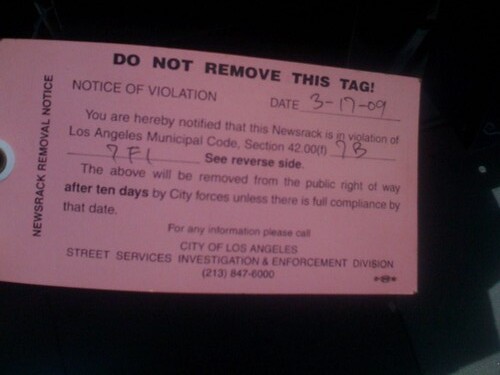
Figured this sentiment – said better than I’d be able to – should probably be reiterated as much as possible in the world of “pink slips and yellow unions.”

 We must defeat arguments such as this one: “We can give, say, attorneys for the Union reasonable raises; there are only about sixty of them. We couldn’t do the same for teachers; there are 20,000 of them.” No. This is no argument. First, I want to know whether teachers are important or not. I want to know whether their salaries are insufficient, whether their task is indispensable or not. It is on such questions that this difficult and long struggle, which calls for patient impatience on the part of educators and political wisdom from their leadership, must be centered. It is important to fight against the colonial traditions we bring with us. It is imperative that we fight to defend the relevance of our task, a relevance that must gradually (but as quickly as possible) become incorporated within society’s most general and obvious stratum of knowledge.

The more we acquiesce to being made into coddling mothers, the more society will find it strange that we go on strike and demand that we remain well behaved.

Conversely, the sooner society recognizes the relevance of our profession, the more it will support us.

Paulo Freire

An Open Letter to the Manual Arts Community about Teacher Layoffs

Manual Arts Community,

As a B-Track teacher I feel both confused and anxious about what’s taking place today. Through the online social networks I belong to, I’m already aware of at least one teacher that’s gotten a pink slip today. I can only assume that this person is not the only one getting such a slip today.

I hear and read rumblings of student walkouts throughout the city and demonstrations at various school sites but don’t get a clear picture of what our school’s teachers, administration, or community are doing about these possible cuts in our staff.

While I hope there is more communication on campus, I am feeling frustrated about the lack of information being disseminated to the entire community. I realize that “official” information may be limited at this point, but I don’t see that as any reason why we cannot, as a community, organize to protect the best assets that Manual Arts has in preparing our students for the future.

I’ll admit that having a face to associate with Pink Friday is helping fuel my anger. While I may have been aloof about the implications of what these cuts may mean, I can’t imagine I was the only one in this position. It would be really helpful for our community to know who has received these slips for us to help rally behind and support these individuals and the welfare of our students. I am encouraging all of us to come forward as we are notified of the pink slips we receive throughout the day. Our union, at one point, discussed wearing buttons – it would be incredibly powerful if buttons, posters, and informational handouts had faces and names for our parents and students to associate with the cuts. Though this may be an uncomfortable proposition for our newer teachers to be recognized, this is not a time for us to hide behind newbie propriety.

I don’t feel like I am being informed properly about what our school or our union is doing while I am on “vacation.” I feel frustrated that I was not informed by my school about the UTLA demonstrations at Beaudry last Tuesday and I am asking for help and support from our union, our administration, and our community at large. I continue to learn from our veteran teachers about the many struggles and strategies they have gone through in the past and look forward to these individuals continuing to support our efforts with their expertise.

Again, I am asking for support and information about how all of us can be of use in this communal struggle on a daily basis. I apologize not for the bitter tone of this email but for the fact that I’ve been so benighted about the way these cuts will affect our school.

Thank you for your time and your understanding.

 In solidarity with all of you receiving a pink slip today,

Antero Garcia

Learning to Breathe Underwater

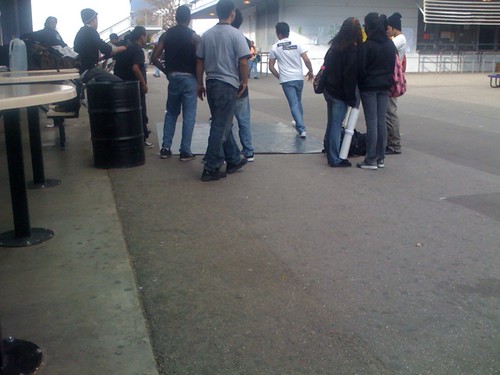
 Yes, that’s a group of kids learning to break dance at my school. I was thrilled to see it. As I walked away, I walked behind two girls talking:

       What’s that? Is that called, like, break dancing?

       Yeah, I think so.

       That’s weird.

It basically being finals week for me, things have been a bit hectic on the doctoral side of things (hence the rather long gap between updates in these here parts of the woods). However, I’ve been thinking lately about the implications of space and understandings of it. This relates in numerous ways to research I’m doing in my classes: space and meaning in disciplinary interactions between students and adults, the way graffiti “codes” space within the Manual Arts community, the way new media opens up and occludes space based on access, etc.

I’ve also been trying to think about the way one’s personal space needs to be made more explicit – labeled even, though that sounds wrong and not at all the way I think of borders as splitting us into different people or different kinds of people. (These are thoughts that demand run ons.) I think one of my biggest flaws over the past two quarters has been about being too amorphous. I don’t think I’ve done quite enough reflecting to really make sense of this here other than to say I’m working toward reprioritizing the way I deal with the different hats I wear. Even within the school setting, the teacher hat, mentor hat, advisor hat, and all-that-stuff-that-takes-place-outside-of-my-class-that-gets-mistakenly-labeled-as-“important” hat are occasionally being donned in the wrong order and for the wrong duration. I don’t want to say like I feel like I let my kids down this quarter, but – like most of us – I certainly think I could have given them more. And of course that’s what they deserve and that’s what they should be demanding. Within other spheres I think I’ve been complicating things by continuing to wear – say – the “doctoral student” hat way too often when maybe the hat I should be wearing is something like the wash-the-dishes-and-make-sure-Sadie-isn’t-destroying-the-house hat. Perhaps this sounds more mundane than what I mean but (and again with the run on) space is being construed and interpreted too fluidly and I’m not coming up for air frequently enough to realize that swimming goggles are out of place in a jacket and tie affair. 

Arthur has been consistently great with it’s online content. A couple of links I’m throwing here come directly from them, so please support your local/global counterculture zine as much as possible – one of the few publications I feel strongly bout schlepping for. In any case, this article on the NYU occupation felt thrilling. It – also about space – makes me cognizant about the challenges with actualizing the kinds of libratory changes many of us are trying to instill in our students. I’m not worried about how they will be viewed or judged by the mass media, but the article makes it clear what script-flipping will need to look like. Similarly, our Third Space Collaborative met for the second time yesterday. I plan to jot something about that when I find another free moment. Suffice for now, I’ll throw out a thought: is this considered an eco-third space? I think of the tenuous balance between living on and off grid simultaneously and the way such a space could function academically (and no, charters are NOT doing this).

 Finally and hot off the presses… er… hot from the oven? I’m excited about the playtest that Greg just wrote about. I think Greg’s game fits in well with this post’s weakly culled theme of space and interpretations of it. I’d be inspired to jump into participating in round 2 of this baking madness if only my biscuit making skills were up to snuff (Daye: kick the recipe over here!). Perhaps my Koreatown neighbors could settle for muffins?

Because I’m all for using the word “oppressors” in the lunchroom over a chalupa: Boy-Silent Day and an example of a Best Practice

After getting an email largely excerpted below, I asked friend and colleague Kate, an elementary school teacher, if I could share her story here. Below, she spells out an exciting activity she conducted, which I’m thrilled about adapting for students that are nearly twice the age of her 10 and 11-year-old students. Enjoy! [Kate’s words follow, student names removed.]

Something great happened today. When I tried to share this with my colleagues at lunch today, I was kind of met with silence and then I felt weird for being “too political.” I muttered to myself on my way out of the lounge “Who actually uses the words ‘oppressors’ in the lunch room over chalupa???” but I can tell you, right?

A couple of months ago, after saying, for the millionth time, “Can I hear from one of the females in the house?” One of the boys said, “They don’t like talking.”

Me: “Oh really? Why do you think that’s so?”

“Cuz they’re shy.”

Another boy: “Cuz they don’t know the answers.” etc.

Since then, I pointed out to them that pretty much whenever a girl opened her mouth, the boys either: shut her down, started talking to a neighbor, or interrupted her. I thought of a “boy silent day” and asked them about a month ago what they thought of it, as an experiment. They agreed in the spirit of exploration. We’ve discussed homophobia, racism, and sexism, and when we discussed this habit of theirs, it was always as an observation, not a judgment. I’m assuming this is why they were willing. I think they were also genuinely curious to see what would happen.

So today we had our “boy-silent day.” We posed it like a science experiment. We had discussed this several times in the past and they knew it was happening today. All but one boy was on board (and even the nay-sayer went along with it). We discussed the goals–everyone was clear that this was in no way a punishment, but an exploration into why the girls don’t participate more. We started with a question–what will happen if the boys don’t talk? Then we thought-paired-shared, made a list of predictions, and then dealt with ground rules (“What if I have to use the bathroom?” “What if two boys are in a partnership?” “What do we do for think-pair-share or group work?”). This was fun and collaborative; we came up with answers together. We discussed the use of body language to communicate and that the boys could still participate, but in silent ways (like attentive listening, e.g.). Everyone kept a sheet of paper at their seat so they could jot down observations of the class and their feelings throughout the day.

And the day started. I have to say, from a teacher’s point of view, my day felt stress-free. There were literally no behavior problems and no distractions. I had no private interventions. During writing workshop–quiet, calm, focus. During independent reading, the same. Incredible. The boys, to their credit, kept their commitment! During directed lessons, they didn’t call out, they didn’t sabotage. They were so mature and reflective. I have had a very challenging year. Many of my little ones struggle with academics and impulse control, so this was all the more exciting (btw–my class is 2/3 male and 1/3 female). The girls did not overwhelmingly participate (i.e. pretty much the same few girls who normally participate were the ones participating), but they seemed…more in control. More confident. They were chatty in the hallways. Was I imagining that I saw more of them smile? I dunno…but it seemed like it. Maybe it was me–giving them more attention, noticing them in ways I hadn’t prior. We joked around at several points throughout the day and it felt so collegial and close, like we were sharing something special.

We spent the last hour or so of the day debriefing. We started with a quickwrite, answering two questions: 1. What have I learned (about myself and the class) from this experiment? And 2. What will I do differently as a result of this experiment? Then we sat in a circle on the rug and discussed these same things. Many boys expressed their frustration and boredom during the day. At one point, [a girl] said, “It felt…weird…because when we talked, they were, like, listening.” Some girls spoke of how the boys made efforts to give them eye contact and to show them through body language that they were present, but some said that the boys did not do this. This was an opportunity to revisit the meaning of sexism and how it appears and gets perpetuated. One boy said, “Can we have a girl silent day?” to which I responded, “What would be the goal?” [Another boy] said, “So they know how we feel!” [Another boy] said to him, “They already know how we feel. This is how they feel all the time.” At the end, we went around and said one thing that we would do differently as a result of today. A shy boy said, “I’m gonna raise my hand more and take risks.” Another said, “I’ve been disrespecting girls; I haven’t been listening to them. I’m gonna listen more.” Another: “I’m going to try not to interrupt.” One of the girls who is a frequent participant said, “I’m going to step back so others can share.” A shy girl said, “I’m going to risk myself more.”

I asked them to do some writing tonight about their thoughts, and I’m excited to read their essays. One boy who stays after school with me wrote something like, “For girls to feel safe, the boys need to listen to them.” One thing I’ve said to them is that sexism doesn’t get crushed if it’s only females fighting against it, that we need boys and men to recognize it and fight against it too. I was really pleased with today and proud of the maturity of these 10 and 11 year olds!

Two final stand-out comments from kids about the day: one girl said, “This was the best day of my life” (remember, she’s 10!) and a boy had written on his observation sheet, “It’s so quiet in here. I feel like I can learn more.”

“We Youth Are Too Strong to be Stopped” (Why We Can’t Get it Right: Listening to the Youth & Civic Education Edition)

 I spent my Friday evening learning. I gained insight about problems within my school, ways these problems could be addressed, and how teachers can improve their instruction. This information was informed by a broad spectrum of graduate level theoretical texts and significant research was conducted; both qualitative and quantitative methods were used. The researchers spoke eloquently and answered questions from leaders within Los Angeles’ educational community. These researchers were a group of brilliant 11th graders at five high schools throughout the city, including Manual Arts.

The Council of Youth Research, put together through UCLA’s IDEA, spent the past seven months investigating their research question: What form of teaching and learning do Los Angeles’ youth need to become powerful civic agents?

The students integrated heady academic texts into their presentations. They explained the ideas presented by writers like Freire, Jean Anyon, and Angela Valenzuela. They explained why what they were doing is a kind of “transformational resistance.”

Based on teacher interviews and teacher surveys, it became clear that – generally:

  • Teachers are teaching about community issues, at least occasionally, but are not requiring students to take action.
  •  Schools are not helping “students develop personally.”
  • Curriculum does not develop civic-minded student
  • “A happy teacher does not always equal a good teacher”
  • Teachers are unprepared for conditions in urban schools like lockdowns.

Ultimately, teachers have a huge potential to get students to become “Justice-oriented citizens” (as the students quoted in Westheimer and Khane, 2004). However, this opportunity is being squandered. I realize a handful of us could get uppity and self-righteous about this. Cleveland High School, for instance, came out of the presentation excelling well-beyond schools like Manual Arts and Roosevelt. However, their relative excellence only points to the lack of equity within the district. For every teacher and every school that does well, an opportunity for the students engaged in those classes and schools to fight for widespread equity should arise to further transform society through schools.

The Manual Arts students made three major recommendations based on their research:

  • More teachers
  • More classrooms
  • Smaller class size

As our school continues in our transition year as a part of the iDesign, I thought about what the students from Locke High School – now a Green Dot charter school stated: “The most noticeable changes [to their campus over the past year] are superficial and cosmetic.” What will the legacy of our school’s attempt at local autonomy become? Will it be school uniforms?

When the Council finished presenting, a member of the group stated, “We are taking matters into our own hands by telling you what we need.” They then received comments and questions from three distinguished guests:

  • Luis Sanchez, School Board President Monica Garcia’s Chief of Staff
  • Omar Del Cueto, Executive Director of iDesign Schools
  • “The only Steve Barr in Los Angeles,” founder of Green Dot

However, as these experts in education spoke, I didn’t feel like they listened to the students. Sanchez questioned what schools could do to be more involved, even though the two hour presentation directly addressed this.

As the Council furthers its work, I’m curious what they’re planning to do next. Professor Ernest Morrell explained that the group is focused on a “model of reciprocation.” I’m wondering how they will expand their network both within their school communities and with other schools not initially represented in this inquiry. I’m also curious what their next steps will be in terms of action: how long will they wait until Del Cueto doesn’t take their ideas into account when running iDesign? How long do they wait if the School Board does not dramatically address civic education? Or if Locke continues to affect only cosmetic changes while triaging to serve its most promising students? I’m thrilled by the possibilities that Friday night’s presentation brings and hope the students take to heart Morrell and his colleague Proessor John Rogers’ warning that the program the students went through can only take them so far. The real change and the real work is still up to them.