– That’s Toni Morrison?
– She looks scary.
– I’d date her.
– That’s Toni Morrison?
– She looks scary.
– I’d date her.
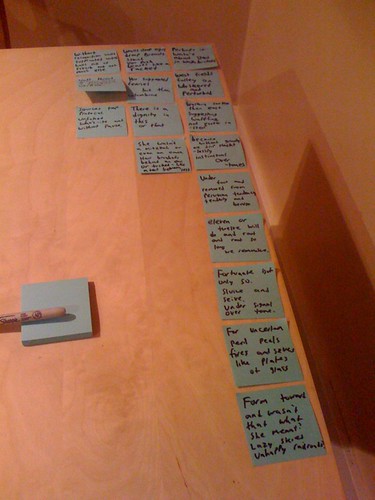
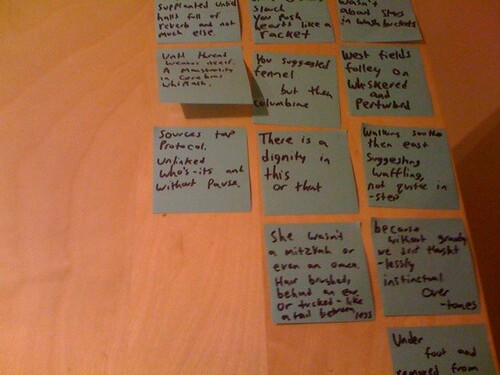
I’m working on a new game. A poetic version of Scrabble or Bananagrams, perhaps. Not quite sure if anything will come of it or if it’s even anything other than a connect-the-dots, writing-exercise solitaire. As I work through more exercises like these, I’ll likely only post those that are somewhat playable. I will also be unveiling a new space for research & dissertation discussion in the next week or two.
I’m getting tired reading different understandings of what constitutes a “game” as both “play” and “competition” or what have you. As I think about applicability in the classroom, I wonder what makes a game “fun” for you?
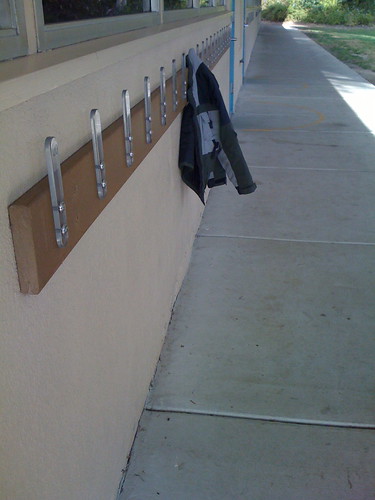
The table is a civilizing place. It’s where a group comes and they hear points of view, they learn about courtesy and kindness, they learn about what it is to live in a community – live in a family first, but live in bigger community. That’s where it comes from, don’t you think?
And
And I just feel like the best way to inflence those kids is to help educate them in the public school system and to teach them to open their senses. Do you know that eighty-five percent of kids in this country don’t eat one meal with their family a day? I think we just forgot, you know. It just got thrown out that idea of being around a table. And we don’t know what got thrown out with it. There are a lot of things that happen around a table; even if you don’t like what’s on the table and you can’t communicate with your family, you have to sit there in a way and wait ’til that guy stops talking so that you go pass the bread to another or use a napkin or a fork or a knife. And those things are becoming very foreign to a lot of children! It’s an offering to-someone-who-needs-food. It’s healing. And I think that’s what the table is! It’s an offering to nourish people! And the more you’re out there, the more you realize what’s upstream is coming downstream. The more you realize that, you know, we’re all sort of connected here.
From this play, incidentally. (Will be reading with the eleventh graders in two weeks.)
– Can you make the robot do something cool?
– Yes, there’s a competition.
– What’s it going to do?
– It’s going to kick balls.
– You can concentrate at your house. I’m not reading bread bags at your house.
We discussed this article in my classes today – didn’t get the copies until this morning, otherwise it would have been yesterday. The move away from single narratives and the critique of “change” and “revolution” fits nicely with the texts in all three of my classes: Song of Solomon, Zoot Suit, and Savage Inequalities.
Imagine Your Thanks
Dropping like trash
Deposited like an investment
Feeding fish
Diving in an exploration
Planting like seeds
Billowing like clouds
Climbing towards forever
Filling a tank, a room, your room, our lives and charting a map of our past, a history of interactions
[The Thank Tank is still looking for hosts for one and two week periods. Please get in touch if you are interested.]
“And besides, it’s a kind of game, a kind of game like dice. You ask what’s this? No. 15? You never or only rarely will you know what it is, because for example when you think … well here, there are twenty or so bottles, and …”
– Daniel Spoerri
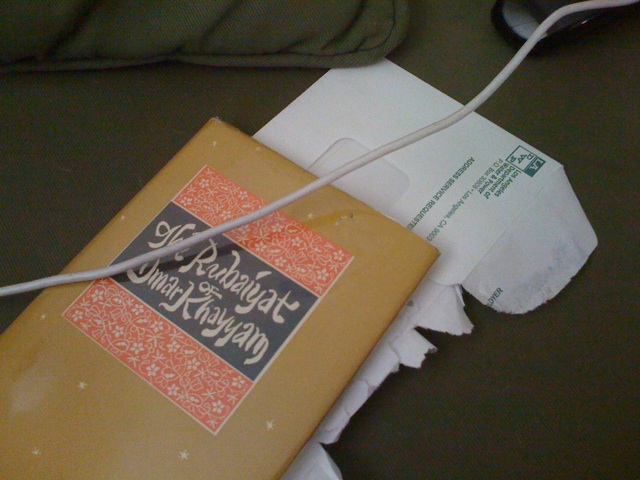
Last week I finished reading Daniel Spoerri’s An Anecdoted Typography of Chance. It is a worthy addition to the series of BSRAYDEKWTDWT (as defined – by me – in this post as Books So Ridiculously Awesome You Don’t Even Know What To Do With Them). I don’t remember in what context, but I know that this book was recommended by friend and all around recommendor of awesome things, Tosh. I encourage everyone to check out the books he publishes as creator of Tam Tam Books.
In any case, the description on the back of the book will best explain how the Typography functions:
What is the Topography? Hard to explain an idea so simple yet so brilliantly executed. Following a rambling conversation with his dear friend Robert Filliou, Daniel Spoerri one day mapped the objects lying at random on the table of his room, adding a rigorously scientific decription of each. These objects subsequently evoked associations, memories, anecdotes; not only from the original author, but from his friends as well: a beguiling creation was born. Many of the principal participants of FLUXUS make an appearance (and texts by Higgins, Jouffroy, Kaprow, Restany, and Tinguely are included, among others). It is a novel of digressions in the manner of Tristram Shandy or Robbe-Grillet; it’s a game, a poem, an encyclopaedia, a cabinet of wonders: a celebration of friendship and creativity.
The map of the table-top has been reproduced as a fold-out at the back of the book.
As Spoerri writes, “Without the outline the Typography wouldn’t make any sense, and without the text the outline wouldn’t make sense.”
It’s not really a secret that I’ve long been a fan of experimental literature and the way folks like the Oulipo play with form. What I liked here was the way this single momentary unit of items functions as a portal into stories. As one object refers to another, we are chased down one rabbit hole of story to another. We twist into etymology and are thrown back to autobiography with a tube of glue or an inauspicious collection of bread crumbs. Though Spoerri’s credited as the author, the interplay between the other contributors both across translations and across time elucidates the way stories unfold unexpectedly based on the personal stances we take towards objects.
It doesn’t look like there are any cheap copies of this floating around online – I’m not really sure where or how I acquired my copy, but it is the same version as the link at the beginning of this post. In any case, I can imagine students creating their own Typographies of Chance as a useful means of telling concrete stories. I can imagine entire constellations of student typographies overlapping haphazardly and inculcating the youth in a network of authorship.
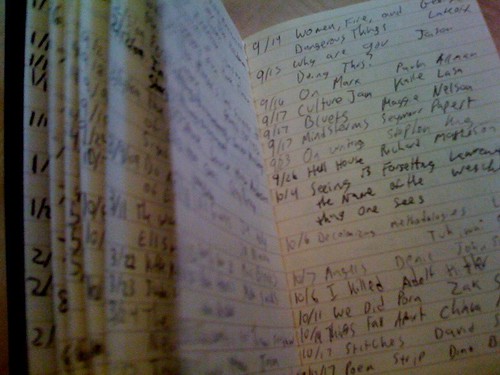
[because one of my more neurotic routines is that I keep a small notebook with the books I’ve read arranged by date.]
Books read in 2009: 91
Comics and graphic novels included in reading total: 12
Books of poetry included in reading total: 5
Books reread included in reading total: 6
Education related books included in reading total: 28
“YA” books included in reading total: 7
Clearly, a significant chunk of the books I read this year were related to school and to school. The thing about grad school is that there are often a whole bunch of articles and papers I’ve read that aren’t reflected on this list (they become part of the collective flotsam that is my EndNote library – itself another haphazard list of materials read). Why do I keep such a list? Most practically, because I’ve come to accept that I have a terrible memory: flipping through the notebook, there are several titles I don’t even remember (I read this? And this? Really?).
A few highlights in my year of reading:
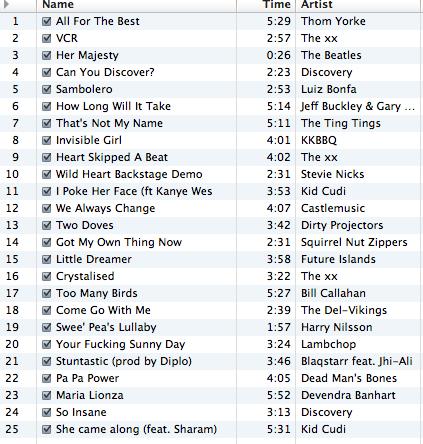
As far as music goes, considering that I got this computer a third of the way through the year, my iTunes most played list serves as a useful indicator of what was what (how Squirrel Nut Zippers made it so high up the list is beyond me… though I think frequent use of the song to wind up Sadie may have something to do with it).
The Thank Tank has been created! General information, tank location, and (eventually) woven text are available at the Thank Tank’s Home. This post will be an updated area to discuss the game’s mechanics, answer questions, and encourage dialogue related to the game.
If you haven’t already, please watch the short instructional video below.
Thank Tank Instructions from Antero Garcia on Vimeo.
The Thank Tank is also looking for spaces in Los Angeles to reside for a week or two at a time. If you have an office, a lobby, or a space that will receive some foot traffic, drop us a line .
Likewise, if you’re not in Los Angeles and want to contribute to the Thank Tank, single-folded post-its can be mailed to:
842 Terrace 49, Los Angeles, CA 90042.
Is the Thank Tank a Game?
The short answer is yes. Think of it as the opposite of hitting a piñata. With a piñata, the goal is to be the first to break and empty the vessel to reap the hidden rewards. Instead, the goal of the Thank Tank is to help fill an empty vessel; the morsels of gratitude are a collective incentive. The thick ink of the Sharpie and the limited space of the post-it help build anonymity within the project. As the thanks proliferate, they will be posted and woven at neededtosaythanks.com.
This is still a bit of a work in progress. The Thank Tank needs a simple logo. Someone needs to design it. Maybe it is you. Other ideas, questions, and suggestions are appreciated.